Babcock University
Babcock University

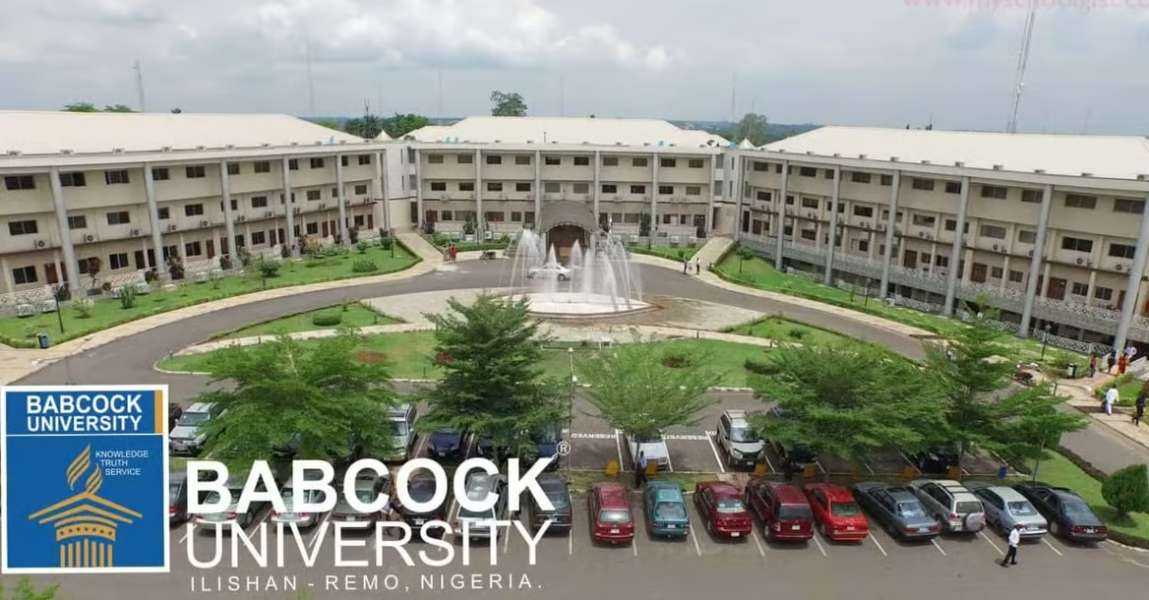
Babcock University which is a private Christian co-educational university owned and operated by the Seventh-day Adventist Church in Nigeria. Located in Ilishan-Remo, off the Sagamu-Benin Expressway, Ogun State, the university sits equidistant between Lagos and Ibadan in South-West Nigeria. Formally inaugurated on 20th April 1999, Babcock was one of the first three private universities accredited by the National Universities Commission (NUC) in Nigeria. With over 12,000 students, more than 20,000 alumni worldwide, and 8 colleges offering over 50 undergraduate and postgraduate programmes, Babcock is consistently ranked among the top 5 universities in Nigeria. It is recognised as the 2nd most efficient university in Nigeria according to NUC efficiency rankings, and over 90% of its graduates are employed within one year of graduation. The university is named after David Caldwell Babcock, an American Seventh-day Adventist missionary who pioneered the work of the SDA Church in Nigeria in 1914. The current Vice-Chancellor is Professor Ademola Tayo.

History of the Institution

The story of Babcock University stretches back to 1959, when seven pioneer students cleared a site in Ilishan-Remo to begin what would become a historic institution. The university traces its origins to the Adventist College of West Africa (ACWA), formally established in September 1959 with those seven students, who were initially hosted at the home of Chief Olufemi Okulaja. It was the realisation of the missionary efforts of David Caldwell Babcock, who arrived in Nigeria in 1914 and pioneered the Seventh-day Adventist Church in the country.

In 1975, ACWA was renamed the Adventist Seminary of West Africa (ASWA), broadening its academic scope and establishing affiliations with Andrews University, Berrien Springs, Michigan, USA, which enabled it to award degrees. In the early 1990s, the institution changed its name to Babcock College and secured an affiliation with the University of Ibadan (UI) to widen its reach within Nigeria’s formal education system.

The pivotal turning point came in 1999, when a delegation from the National Universities Commission (NUC) granted the institution full university accreditation, making it one of the first three private universities to be officially recognised in Nigeria. The university was formally inaugurated on 20th April 1999. Its first batch of 1,006 students arrived on 13th September 1999, and the Matriculation Ceremony was presided over by Pastor and Professor Jan Paulsen — then President of the General Conference of the Seventh-day Adventist Church from Washington D.C., USA — on 28th January 2000.

The university commenced academic activities with three pioneer faculties — Education and Humanities, Management and Social Sciences, and Science and Technology — with eleven departments. The School of Law and Security Studies later became the fourth school. A Postgraduate School was established in 2010. The Benjamin S. Carson (Snr.) School of Medicine was established in 2012, with its first set of graduates inducted into the medical profession in 2017. The 7th graduation ceremony on 7th June 2009 marked both the 50th anniversary of the institution and its 10th anniversary as a university.

Today, Babcock University operates across two campuses: the main campus at Ilishan-Remo (housing all non-legal schools, the Babcock University Teaching Hospital, administrative centres, the postgraduate school, a state-of-the-art sports complex, and student accommodation halls), and a law campus in Iperu-Remo housing the School of Law and Security Studies. Among its notable achievements are pioneering arthroscopic ligament construction in Nigeria and hosting the first SDA-owned medical school in West Africa.

Location

Babcock University Ilishan-Remo, Off Sagamu-Benin Expressway Ogun State, Nigeria

Main Campus: Ilishan-Remo, Ogun State (all non-legal schools, Teaching Hospital, PG School) Law Campus: Iperu-Remo, Ogun State (School of Law and Security Studies)

The university is located approximately 80 kilometres from Lagos and is easily accessible from both Lagos and Ibadan via the Sagamu-Benin Expressway.

List of Courses Offered by Babcock University

Babcock University currently offers over 50 undergraduate and postgraduate programmes across 8 colleges. JUPEB (A-Level), Pre-Degree, and part-time programmes are also available.

College of Health and Medical Sciences

Benjamin S. Carson (Snr.) School of Medicine:

  • Medicine and Surgery (MBBS) — 6-year programme
  • Human Anatomy
  • Human Physiology

School of Nursing Sciences:

  • Nursing Science (B.Sc. Nursing)

College of Sciences and Science Education

  • Biochemistry
  • Biology
  • Chemistry
  • Computer Science
  • Industrial Chemistry
  • Mathematics
  • Microbiology
  • Physics

College of Agriculture and Industrial Sciences

  • Agricultural Economics and Extension
  • Agricultural Science
  • Animal Production

College of Engineering

  • Civil Engineering
  • Computer Engineering
  • Electrical and Electronics Engineering
  • Information and Communication Engineering
  • Mechanical Engineering
  • Software Engineering

College of Management and Social Sciences

  • Accounting
  • Banking and Finance
  • Business Administration
  • Economics
  • International Relations
  • Mass Communication
  • Political Science
  • Public Administration
  • Sociology

College of Education and Humanities

  • Christian Religious Studies
  • Education (various combinations)
  • English Studies
  • French
  • History and International Studies
  • Languages and Literary Studies
  • Music and Creative Arts

College of Law and Security Studies (Iperu Campus)

  • Law (LL.B.)
  • Criminology and Security Studies

College of Public and Applied Health

  • Environmental Health Science
  • Health Information Management
  • Public Health

School of Postgraduate Studies

  • Postgraduate Diploma (PGD), Master’s (M.Sc., MBA, M.A., LL.M.), and Ph.D. programmes across multiple colleges

For the complete and most up-to-date list of programmes, please visit babcock.edu.ng/programs 

Admission Requirements

UTME (Undergraduate) Admission

  • A minimum of five (5) O’Level credit passes including English Language and Mathematics, obtained in not more than two sittings in WAEC, NECO, GCE O’Level, or NABTEB.
  • A valid JAMB UTME score is required. Candidates must select Babcock University as their institution of first choice on JAMB. Babcock does not accept second-choice candidates.
  • All eligible candidates must participate in the Babcock University Post-UTME screening test, which consists of a written examination and oral interview.
  • Minimum JAMB score: 160 for general programmes; 180 and above for science-based courses including Microbiology, Biochemistry, Computer Science, and Engineering; 200 and above for Medicine and Surgery and Law.
  • Additional faculty-specific O’Level requirements apply — for instance, Medicine and Surgery requires credits in Mathematics, Physics, Chemistry, Biology, and English Language.

Direct Entry Admission

  • Candidates with A’Level passes, ND (Upper Credit), HND, NCE, or equivalent qualifications may apply for Direct Entry into 200 Level.
  • Relevant O’Level and departmental requirements apply.

JUPEB (A-Level) Programme

  • Babcock offers the Joint Universities Preliminary Examinations Board (JUPEB) A-Level programme as a pathway to Direct Entry into 200 Level at Babcock or other participating universities.

Pre-Degree Programme

  • A one-year foundation programme available for candidates preparing for direct undergraduate admission.

Postgraduate Admission

  • A Bachelor’s degree with at least Second Class Lower Division from an NUC-accredited institution.
  • NYSC Discharge or Exemption certificate.
  • Departmental requirements and references apply.

Apply for Admission: babcock.edu.ng/admission

Please see the latest news below or visit the school website for the most current admission requirements and deadlines.

School Fees

Babcock University is a fully residential private university, and its fee structure is notably different from public universities. Fees cover tuition, accommodation, feeding (three meals daily at university cafeterias), ICT services, health care at the Teaching Hospital, and student activities — all bundled into a single comprehensive annual payment. This means that once fees are paid, there are no hidden charges mid-semester.

The last known undergraduate school fees for the 2025/2026 and 2026/2027 academic sessions range from approximately ₦392,746 to ₦2,001,987 per session, depending on the programme and level of study. Some key figures include:

  • Education and Humanities programmes: approximately ₦500,000 — ₦800,000 per session
  • Management, Social Sciences, Mass Communication, Political Science, International Relations: approximately ₦600,000 — ₦1,000,000 per session
  • Science, Computer Science, Engineering: approximately ₦568,807 — ₦739,449 per session (tuition only, excluding accommodation and feeding)
  • Law (LL.B.): approximately ₦700,000 — ₦1,200,000 per session
  • Nursing Science (100 level): approximately ₦1,484,173 per session
  • Medicine and Surgery (100 — 200 level): approximately ₦7,000,000 per session (inclusive of accommodation and feeding)
  • Medicine and Surgery (300 — 400 level): approximately ₦6,000,000 per session
  • Medicine and Surgery (500 — 600 level): approximately ₦5,500,000 per session

Laboratory-based courses attract an additional laboratory fee of approximately ₦50,000 per session.

Acceptance fees are as follows:

  • General undergraduate programmes: ₦150,000
  • Law students: ₦250,000
  • Medicine and Surgery students: ₦300,000

Hostel fees (for non-medical students, accommodation is optional) are as follows:

  • Regular hostel: approximately ₦99,120 per session
  • Premium hostel: approximately ₦141,600 per session
  • Classic hostel: approximately ₦212,400 per session

Postgraduate fees range from approximately ₦400,000 — ₦600,000 for PGD, ₦600,000 — ₦1,500,000 for Master’s programmes, and ₦1,000,000 — ₦2,500,000 for Ph.D. programmes per session.

Fees are paid online via the student portal at babcock.edu.ng. Instalment payment is available, but at least 55% of fees must be paid before the start of the session, and the remaining 45% by the end of the session. Payment can be made by bank draft, wire transfer, POS, mobile money, or online via debit card.

Please see the latest news below or visit babcock.edu.ng/finance/tuition-and-fees for the most current and officially confirmed school fees schedule.

Cut-off Mark

The last known JAMB cut-off mark for Babcock University is 160 as the general minimum for all courses. However, competitive science-based courses including Microbiology, Biochemistry, and Computer Science require 180 and above, while Medicine and Surgery and Law require 200 and above. Babcock requires candidates to have selected the university as their first choice on JAMB.

Please see the latest news below or visit the school website for the most current and officially confirmed departmental cut-off marks.

Hostel / Accommodation

Babcock University is a fully residential campus, and hostel accommodation is available for all students. For Medicine and Surgery students, accommodation is compulsory and is included in the course fees. For students in other programmes, accommodation is optional. The university offers three categories of hostel accommodation: Regular (approximately ₦99,120 per session), Premium (approximately ₦141,600 per session), and Classic (approximately ₦212,400 per session). All residential students enjoy three meals daily at the university’s cafeterias. Cooking in hostels is not permitted.

Please see the latest news below or visit the school website for the most current hostel fees and accommodation procedures.

Scholarships

Babcock Innovation Challenge 7.0 Registration

Registration has opened for the Babcock Innovation Challenge 7.0, a student entrepreneurship programme designed to give Babcock University students an opportunity to develop ideas into practical business, technology, service or community solutions.

Participation is open to teams of three to five students, with every team member required to be a registered member of the Babcock University Student Entrepreneurship Club (BUSEC). The challenge will progress through three stages: application, semifinals and the grand finale.

The semifinal stage will feature 10 teams, while five teams will advance to the grand finale. Participants will be expected to identify problems, work collaboratively and develop ideas that can provide useful solutions while building their creativity, competence and entrepreneurial skills.

Registration will close on 31 October 2026. Interested teams should submit their applications through the official BUSEC registration page before the deadline.

Notice Board

Babcock University Revises Resumption Dates for 2026/2027

Babcock University has announced revised resumption dates for new and returning students for the 2026/2027 academic session. In a notice issued by its Communication, Media and Branding unit, the university outlined the dates for arrival on campus, registration verification and other resumption activities.

New students, including 100-level and Direct Entry candidates, are expected to resume between Sunday, 18 October, and Tuesday, 20 October 2026, from 9:00 a.m. to 4:00 p.m. Returning students in levels 200–600 will resume between Wednesday, 21 October, and Friday, 23 October 2026. The schedule is organised by school, so students should confirm their designated resumption date from the list released by the university.

For new students, the schedule is as follows: 18 October – Schools of Law and Security Studies, Engineering, Environmental Science, Education and Humanities, Basic Medical Sciences, Science and Technology, and Computing; 19 October – Veronica Adeleke School of Social Sciences and School of Allied Health Sciences; 20 October – Schools of Management Sciences, Nursing Science and Basic Medical Science. For returning students, the schedule is 21 October for the schools listed for the first day of new-student resumption, 22 October for Social Sciences and Allied Health Sciences, and 23 October for Management Sciences, Nursing Science and Basic Medical Science. Returning students will also complete registration activities, including those relating to the 2027 Students’ Industrial Work Experience Scheme (SIWES).

All students are advised to complete their online registration before their resumption dates and arrive with their completed course registration forms. Students should proceed to their selected halls of residence upon arrival, while returning students must present their student receipts or other evidence of semester fee payment before room allocation. The registration portal remains open, and students and parents can visit the Babcock University official website for further information on school fees and other resumption requirements. Students are encouraged to follow the schedule applicable to their schools to ensure a smooth start to the session.

Notable Alumni

Babcock University has produced a number of prominent Nigerians who have distinguished themselves across music, film, politics, and business. Some of its verified notable alumni include:

  • David Adeleke (Davido) – Nigerian singer, songwriter and record producer.
  • Shola Akinlade – Nigerian technology entrepreneur and co-founder/CEO of Paystack.
  • Adenike Akinsemolu – Nigerian environmental sustainability advocate, educator, author and social entrepreneur.
  • Debo Ogundoyin – Nigerian politician and Speaker of the Oyo State House of Assembly.
  • Beverly Osu – Nigerian actress, model and media personality.
  • Olumide Oworu – Nigerian actor and politician.
  • Olamide Samuel – Nigerian international security expert.
  • Aisha Ochuwa – Nigerian lawyer and entrepreneur.

Official Website and Portal Links

Resource Link
Official Website babcock.edu.ng
Admissions Page babcock.edu.ng/admission
Tuition and Fees babcock.edu.ng/finance/tuition-and-fees
Admission Tuition and Fees babcock.edu.ng/admission/tuition-and-fees
Programmes Page babcock.edu.ng/programs
Postgraduate Admissions babcock.edu.ng/postgraduate
Babcock University High School buhs.babcock.edu.ng
Babcock University Teaching Hospital buth.babcock.edu.ng
e-Learning (Moodle) elearn.babcock.edu.ng
Library library.babcock.edu.ng

Frequently Asked Questions (FAQs)

Where is Babcock University located? Babcock University is located in Ilishan-Remo, off the Sagamu-Benin Expressway, Ogun State, South-West Nigeria. It is approximately 80km from Lagos, accessible from both Lagos and Ibadan. The Law School campus is in Iperu-Remo.

When was Babcock University established? Babcock traces its history to 1959 as the Adventist College of West Africa (ACWA). It was formally inaugurated as a university on 20th April 1999 and was among the first three private universities accredited by the NUC in Nigeria.

Is Babcock University a Christian university? Yes. Babcock University is owned and operated by the Seventh-day Adventist Church in Nigeria. It incorporates SDA doctrines and practices into campus life, with mandatory chapel attendance, dress code policies, and a vegetarian-leaning cafeteria.

Does Babcock University offer Medicine and Surgery? Yes. The Benjamin S. Carson (Snr.) School of Medicine offers Medicine and Surgery (MBBS), a 6-year programme. The first set of graduates were inducted into the medical profession in 2017. Medicine and Surgery is one of the most expensive programmes at Babcock, with fees ranging from ₦5,500,000 to ₦7,000,000 per session depending on level.

Does Babcock University offer Law? Yes. The College of Law and Security Studies, located at the Iperu Campus, offers Law (LL.B.) and Criminology and Security Studies.

What is the JAMB cut-off mark for Babcock University? The last known minimum JAMB cut-off mark is 160 for general programmes, 180+ for science-based courses, and 200+ for Medicine, Surgery, and Law. Please see the latest news below or visit the school website for the current figures.

Is hostel accommodation compulsory at Babcock? Accommodation is compulsory only for Medicine and Surgery students. For all other programmes, hostel accommodation is optional. Babcock offers Regular, Premium, and Classic hostel categories ranging from ₦99,120 to ₦212,400 per session.

Does Babcock University accept second-choice JAMB candidates? No. Babcock University only accepts candidates who have selected it as their first choice on JAMB or candidates willing to process a JAMB Change of Institution before the application deadline.

Does Babcock have a High School? Yes. Babcock University High School (BUHS) is a co-educational secondary school on the Babcock University campus. Visit buhs.babcock.edu.ng for more information.

How much are Babcock University school fees? Fees range from approximately ₦392,746 to ₦2,001,987 for most undergraduate programmes, and up to ₦7,000,000 for Medicine and Surgery (inclusive of accommodation and feeding at the clinical levels). Acceptance fees range from ₦150,000 to ₦300,000 depending on the course. Please see the latest news below or visit the official fees page for current figures.

McPherson University
McPherson University – McU

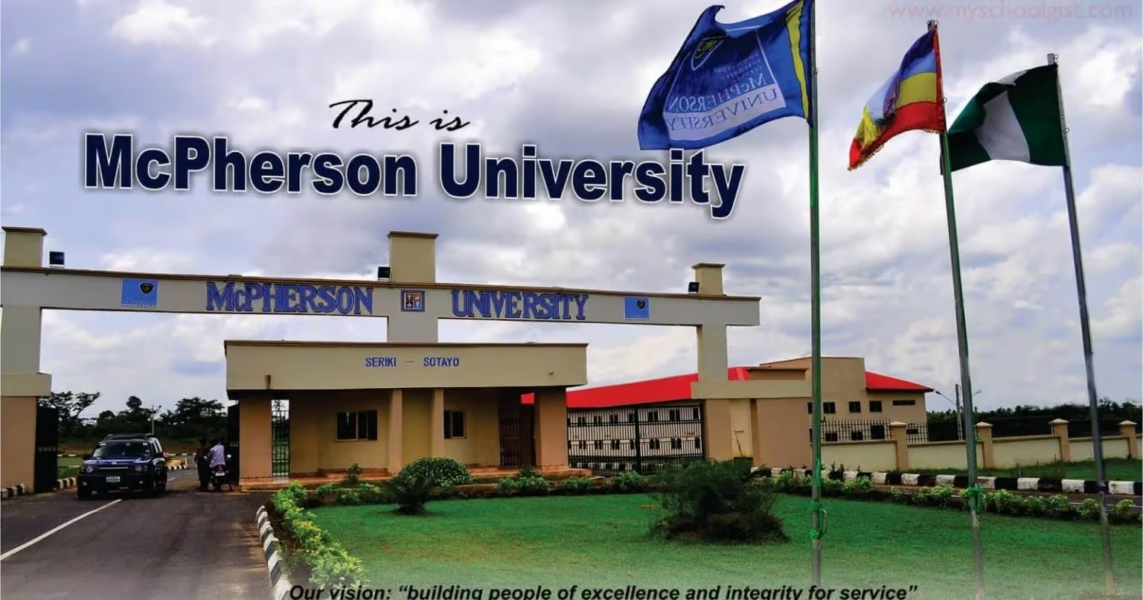
McPherson University  popularly known as MCU is a private Christian university located in Seriki-Sotayo along the Lagos-Ibadan Expressway in Ogun State, Nigeria. The university was established by the Foursquare Gospel Church in Nigeria and officially licensed by the Federal Government of Nigeria through the National Universities Commission (NUC) in 2012. Academic activities commenced shortly afterward with a vision focused on raising morally upright, academically sound, innovative, and globally competitive graduates. (mcu.edu.ng)

McPherson University operates as a faith-based institution committed to integrating academic excellence with Christian values, leadership development, entrepreneurship, innovation, and character formation. The university promotes a disciplined learning environment designed to support intellectual growth, spiritual development, research, and practical education. (mcu.edu.ng)

The institution offers undergraduate and postgraduate programmes across sciences, computing, management sciences, humanities, social sciences, and allied health-related disciplines. McPherson University is also recognized for maintaining a relatively stable academic calendar, structured campus system, and strong emphasis on ethics and discipline. (mcu.edu.ng)

History of the Institution

McPherson University was founded by the Foursquare Gospel Church in Nigeria as part of its broader mission to expand access to quality university education grounded in Christian ethics and academic excellence. The university was named after Aimee Semple McPherson, founder of the International Church of the Foursquare Gospel. (mcu.edu.ng)

The National Universities Commission (NUC) granted the university operational license in 2012, and the institution commenced academic activities at its permanent campus in Seriki-Sotayo, Ogun State. (mcu.edu.ng)

Over the years, the university has expanded its academic programmes, hostel facilities, laboratories, ICT infrastructure, student services, and entrepreneurship training systems. The institution continues positioning itself as one of Nigeria’s growing private faith-based universities with focus on holistic student development. (mcu.edu.ng)

Location

McPherson University
Seriki-Sotayo
Along Lagos-Ibadan Expressway
Ogun State, Nigeria

The university is strategically located along the Lagos-Ibadan Expressway, providing relatively easy access from Lagos, Ibadan, Abeokuta, and other parts of southwestern Nigeria. (mcu.edu.ng)

List of Courses Offered by McPherson University, Seriki-Sotayo

McPherson University offers undergraduate programmes across sciences, computing, management sciences, humanities, and social sciences. (mcu.edu.ng)

College of Natural and Applied Sciences

  • Biochemistry
  • Biotechnology
  • Industrial Chemistry
  • Microbiology
  • Physics
  • Computer Science
  • Cyber Security
  • Software Engineering
  • Mathematics
  • Statistics

College of Humanities, Social and Management Sciences

  • Accounting
  • Banking and Finance
  • Business Administration
  • Economics
  • International Relations
  • Mass Communication
  • Political Science
  • English Language
  • History and International Studies

Allied and Health-Related Programmes

  • Public Health
  • Medical Laboratory Science
  • Nursing Science

Other Programmes

  • Entrepreneurship Studies
  • General Studies

For the most updated programme list, visit:
McPherson University Undergraduate Programmes

Admission Requirements

UTME Admission

Candidates seeking admission into McPherson University are generally required to possess:

  • A minimum of five (5) O’Level credit passes including English Language and Mathematics
  • Relevant subjects related to the intended programme
  • WAEC, NECO, GCE, or NABTEB results
  • A valid JAMB UTME score
  • Correct JAMB subject combination
  • Participation in university screening and admission processes where applicable (mcu.edu.ng)

Direct Entry Admission

Candidates with:

  • ND
  • NCE
  • HND
  • IJMB
  • JUPEB
  • A-Level qualifications

may apply for Direct Entry admission into 200 Level subject to university requirements.

Admission portal:
McPherson University Admissions

Please check school website or latest news below for newest update.

School Fees

McPherson University operates a programme-based tuition structure. Fees vary depending on faculty, laboratory requirements, professional accreditation costs, accommodation, and practical training components. Health-related and computing programmes generally attract higher tuition. (mcu.edu.ng)

Estimated tuition ranges for recent academic sessions include:

Humanities, Social and Management Sciences

  • Approximately ₦500,000 — ₦850,000 per academic session

Natural and Applied Sciences

  • Approximately ₦650,000 — ₦1,000,000 per session

Computer Science, Cyber Security and Software Engineering

  • Approximately ₦750,000 — ₦1,200,000 per session

Nursing Science and Medical Laboratory Science

  • Approximately ₦1,000,000 — ₦1,600,000 per session

Additional charges may include:

  • Acceptance fee
  • Hostel accommodation fee
  • Medical fee
  • ICT fee
  • Laboratory charges
  • Development levy
  • Entrepreneurship training fee

Cut-off Mark

The last publicly referenced JAMB cut-off mark for McPherson University is approximately 140–160 for many programmes, while Nursing Science and other competitive health-related programmes may require stronger scores. (mcu.edu.ng)

Please check school website or latest news below for newest update.

Hostel / Accommodation

McPherson University operates a residential campus system with hostel accommodation available for students. The university promotes a disciplined and secure campus environment designed to support academic concentration, spiritual development, and student welfare. (mcu.edu.ng)

Notice Board

McPherson University Resumption Dates 2026/2027

McPherson University has announced a staggered resumption schedule for the 2026/2027 academic session. Fresh students will resume on different dates according to their colleges, while returning students are expected to resume on 26 October 2026.

Date College/Programme
19 October 2026 Nursing
20 October 2026 Computing
21 October 2026 Medical Laboratory Science and Law
22 October 2026 Humanities, Social Sciences and Management
23 October 2026 Public Health, Health Information Management, Natural and Applied Sciences
26 October 2026 Returning Students

The staggered arrangement is intended to allow the university to inspect and prepare facilities ahead of the arrival of each student group. Fresh students should take note of the date assigned to their college and make the necessary arrangements for resumption.

Students are also advised to complete any required registration and clearance processes and follow further instructions issued by their respective colleges ahead of the resumption dates.

Notable Alumni

McPherson University is a relatively young Nigerian university, established in 2012, and there is currently no public documentation of graduates who have achieved broad national or international recognition.

Official Website and Portal Links

Resource Link
Official Website mcu.edu.ng
About the University About McPherson University
Undergraduate Programmes McPherson University Courses
Admissions MCU Admissions Portal
Student E-Portal McPherson University E-Portal
Contact Directory MCU Contact Information

Contact Information

McPherson University
Seriki-Sotayo
Along Lagos-Ibadan Expressway
Ogun State, Nigeria

Official website:
McPherson University Official Website

Contact directory:
MCU Email Directories and Contacts

Frequently Asked Questions (FAQs)

Where is McPherson University located?
McPherson University is located at Seriki-Sotayo along the Lagos-Ibadan Expressway in Ogun State, Nigeria.

Who owns McPherson University?
The university was established by the Foursquare Gospel Church in Nigeria.

Is McPherson University accredited?
Yes. McPherson University is licensed by the National Universities Commission (NUC), and several programmes maintain professional accreditation where applicable.

What courses are offered at McPherson University?
Courses include Computer Science, Cyber Security, Software Engineering, Accounting, Business Administration, Mass Communication, Nursing Science, Medical Laboratory Science, Public Health, Biochemistry, Political Science, and many others.

How much are McPherson University school fees?
Estimated tuition ranges from approximately ₦500,000 to ₦1,600,000 depending on programme and faculty.

Please check school website or latest news below for newest update.

Does McPherson University offer Nursing Science?
Yes. McPherson University offers Nursing Science and other health-related programmes.

What is McPherson University cut-off mark?
The last publicly referenced cut-off mark is approximately 140–160 for many programmes.

Please check school website or latest news below for newest update.

Does McPherson University provide hostel accommodation?
Yes. The university operates a residential campus system with hostel accommodation for students.

Does McPherson University have a student portal?
Yes. Students can access academic and administrative services through the university e-portal.

What is McPherson University known for?
The university is recognized for Christian faith-based education, moral discipline, stable academic calendar, health science programmes, and structured campus life.

Sule Lamido University (SLU)
Sule Lamido University – SLU

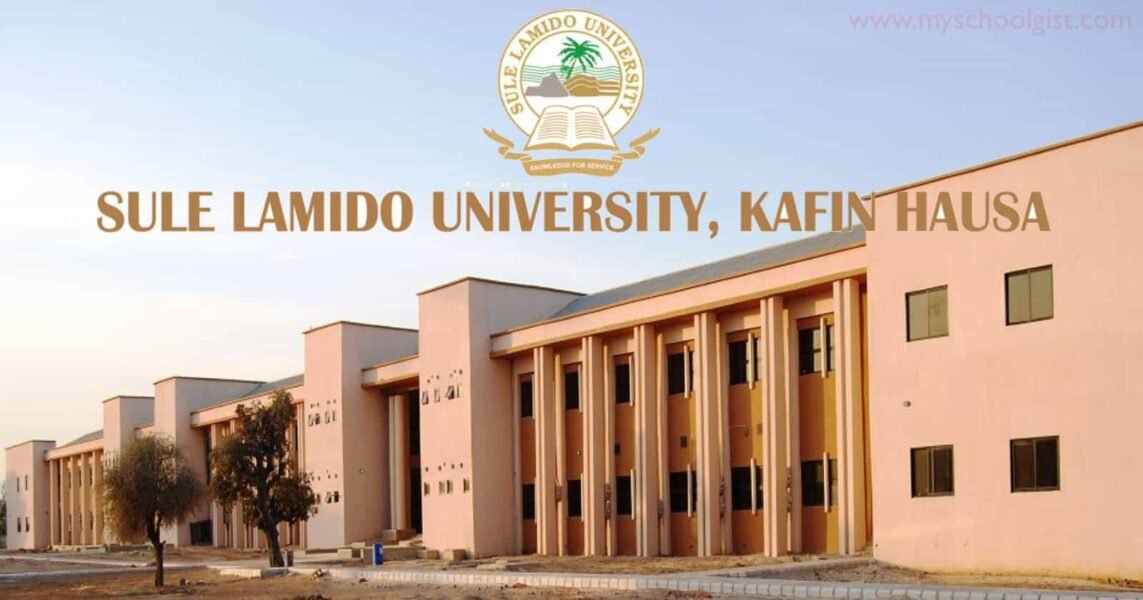
Sule Lamido University  popularly known as SLU  is a public state university located in Kafin Hausa, Jigawa State, Nigeria. Established on 13 May 2013, the university was created by the Jigawa State Government to expand access to quality higher education in Northern Nigeria. It was initially founded as Jigawa State University and later renamed Sule Lamido University in December 2014. The institution is recognised by the National Universities Commission (NUC) and offers undergraduate, postgraduate, IJMB, remedial, and part-time programmes. The current Vice-Chancellor is Professor Lawan Sani Taura.

History of the Institution

Sule Lamido University was established in 2013 and licensed by the National Universities Commission in July of the same year. Full academic activities officially commenced in September 2014.

The university was originally known as Jigawa State University before a bill passed by the Jigawa State House of Assembly changed its name to Sule Lamido University, in honour of former Jigawa State Governor Sule Lamido.

Since inception, the institution has continued to expand its academic programmes, student population, digital portals, and infrastructure development.

Location

Sule Lamido University (SLU)
Km2 Jahun–Kano Road
Kafin Hausa
Jigawa State, Nigeria

Postal Address: P.M.B. 048, Kafin Hausa, Jigawa State.

Faculties / Schools

  • Faculty of Computing and Information Technology
  • Faculty of Education
  • Faculty of Humanities
  • Faculty of Natural and Applied Sciences
  • School of Postgraduate Studies

List of Courses Offered by Sule Lamido University (SLU)

  • B.A. Arabic
  • B.A. English
  • B.A. Hausa
  • B.A. History
  • B.A. Islamic Studies
  • B.A. (Ed) Arabic
  • B.A. (Ed) English
  • B.A. (Ed) Hausa
  • B.A. (Ed) History
  • B.A. (Ed) Islamic Studies
  • B.A./B.Sc. Library and Information Science
  • B.Sc. (Ed) Biology
  • B.Sc. (Ed) Chemistry
  • B.Sc. (Ed) Computer Science
  • B.Sc. (Ed) Mathematics
  • B.Sc. (Ed) Physics
  • B.Sc. Accounting
  • B.Sc. Biology
  • B.Sc. Business Management
  • B.Sc. Chemistry
  • B.Sc. Computer Science
  • B.Sc. Cyber Security
  • B.Sc. Economics
  • B.Sc. Geography
  • B.Sc. Information Technology
  • B.Sc. Mathematics
  • B.Sc. Physics
  • B.Sc. Political Science
  • B.Sc. Software Engineering
  • B.Sc. Sociology
  • B.Agric. Agricultural Economics and Extension
  • B.Agric. Animal Science
  • B.Agric. Crop Science
  • B.Agric. Soil and Land Management

Admission Requirements

UTME (Undergraduate Admission)

Candidates are generally required to have:

  • Five (5) O’Level credit passes including English Language and Mathematics
  • Valid JAMB score
  • Correct UTME subject combination
  • Participation in SLU Post-UTME screening
  • Choice of SLU in JAMB

Direct Entry Admission

Candidates with ND, NCE, IJMB, JUPEB, HND, or A’Level qualifications may apply.

Postgraduate Admission

Applicants for postgraduate study generally require:

  • Relevant Bachelor’s degree
  • Minimum Second Class Lower for many Master’s programmes
  • Additional PGD route for some candidates
  • PhD applicants require a relevant Master’s degree.

Please check school website or latest news below for newest update.

School Fees

SLU school fees vary depending on:

  • Fresh or returning student
  • Undergraduate or postgraduate status
  • Faculty / department
  • Indigene or non-indigene status

Recent postgraduate schedules listed examples such as:

  • MA (Indigene): ₦120,000
  • MA (Others): ₦150,000
  • MSc Science (Indigene): ₦160,000
  • MSc Science (Others): ₦200,000

Additional charges may apply.

Cut-off Mark

SLU cut-off marks vary yearly by programme.

  • General courses may use the approved JAMB benchmark
  • Competitive courses may require higher scores

Please check school website or latest news below for newest update.

Hostel / Accommodation

The student portal shows hostel accommodation processes and hostel fee options for eligible students. One visible fee notice listed ₦10,000 hostel accommodation fee for allocated students.

Notice Board

SLU Graduates 1,332 Students in 2025/2026

Sule Lamido University (SLU) has graduated 1,332 students during the 2025/2026 academic session, with the graduates distributed across five degree classifications.

Class Number of Graduates
First Class 28
Second Class Upper (2:1) 330
Second Class Lower (2:2) 710
Third Class 241
Pass 23
Total 1,332

The largest group was made up of graduates in the Second Class Lower category, with 710 students, followed by 330 graduates who obtained Second Class Upper degrees. A total of 28 students graduated with First Class degrees.

Graduates are advised to follow official communication from the university regarding convocation arrangements, certificate collection and other post-graduation procedures.

Notable Alumni

Sule Lamido University was established in 2013 and began academic activities in 2014. Although the university has produced thousands of graduates since its first graduating sets, there are currently limited publicly documented profiles of alumni who have achieved significant national  recognition.

Official Website and Portal Links

Resource Link
Official Website https://slu.edu.ng/
Admission Portal https://admissions.slu.edu.ng/
Undergraduate Portal https://myslu.slu.edu.ng/ug/
Postgraduate Portal https://admissions.slu.edu.ng/pg/
IJMB / Remedial Portal https://admissions.slu.edu.ng/ijmb-remedial/ijmb

Contact Information

Sule Lamido University
P.M.B. 048
Kafin Hausa, Jigawa State, Nigeria

Email: admissions@slu.edu.ng
ICT Helpdesk: icthelpdesk@slu.edu.ng

Frequently Asked Questions (FAQs)

Is SLU a federal or state university?
SLU is a state-owned university established by the Jigawa State Government.

Where is SLU located?
SLU is located in Kafin Hausa, Jigawa State, Nigeria.

What was SLU formerly called?
It was formerly called Jigawa State University.

Does SLU have a student portal?
Yes. Students use the portal for registration, admission, hostel, and academic services.

Does SLU offer postgraduate programmes?
Yes. SLU offers PGD, Masters, and PhD programmes.

Who is the Vice-Chancellor of SLU?
Professor Lawan Sani Taura.

How do I check SLU admission status?
Usually through the admission portal or JAMB CAPS.

University of Delta
University of Delta – UNIDEL

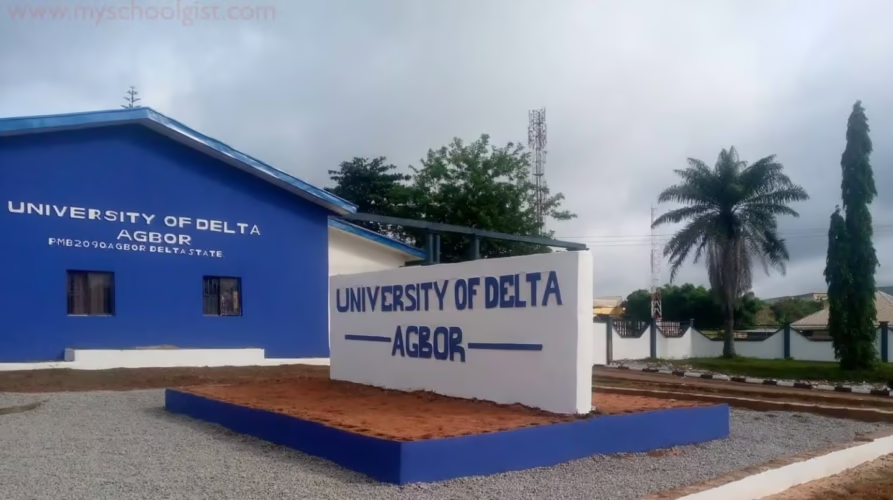
University of Delta  popularly known as UNIDEL  is a public state university located in Agbor, Delta State, Nigeria. Established in 2021 by the Delta State Government, UNIDEL is one of Nigeria’s newest universities and was created to expand access to quality higher education in the state. The university operates a multi-campus system and offers undergraduate and developing postgraduate programmes across various disciplines. UNIDEL is accredited by the National Universities Commission (NUC) and is steadily growing in infrastructure, staffing, and academic offerings.

History of the Institution

University of Delta, Agbor was established in 2021 following the upgrade of existing higher institutions in Delta State into a full-fledged university system. The creation of UNIDEL was part of the state government’s broader effort to improve tertiary education capacity and provide more opportunities for students within the Niger Delta region.

Since its establishment, the university has continued to expand its academic structure, facilities, and student population while positioning itself as a modern institution focused on innovation, research, and professional development.

Location

University of Delta (UNIDEL)
Agbor
Delta State, Nigeria

UNIDEL operates across three campuses:

  • Agbor (Main Campus)
  • Owa-Oyibu Campus
  • Oleh Campus

Faculties

  • Faculty of Arts
  • Faculty of Education
  • Faculty of Science
  • Faculty of Management and Social Sciences
  • Faculty of Environmental Sciences
  • Faculty of Computing

List of Courses Offered by University of Delta (UNIDEL)

  • Accounting
  • Agricultural Economics
  • Agricultural Extension
  • Animal Science
  • Anatomy
  • Architecture
  • Banking and Finance
  • Biochemistry
  • Biology
  • Biotechnology
  • Business Administration
  • Business Education
  • Chemical Engineering
  • Chemistry
  • Chemistry Education
  • Christian Religious Studies
  • Civil Engineering
  • Communication and Language Arts
  • Computer Engineering
  • Computer Science
  • Computer Science Education
  • Criminology and Security Studies
  • Crop Science
  • Cyber Security
  • Data Science
  • Economics
  • Economics Education
  • Educational Administration
  • Early Childhood Care Education
  • Electrical and Electronics Engineering
  • English Education
  • English and Literary Studies
  • Entrepreneurship and Business Innovation
  • Estate Management
  • Environmental Management and Toxicology
  • Fine and Applied Arts
  • Food Science and Technology
  • French
  • French Education
  • Geography Education
  • Geography and Environmental Management
  • Geology
  • Guidance and Counselling
  • Health Education
  • History and International Studies
  • History Education
  • Home Economics
  • Human Kinetics Education
  • Information and Communication Technology
  • Information Science
  • International Relations
  • Law
  • Linguistics
  • Library and Information Science
  • Marine Science
  • Mass Communication
  • Mathematics
  • Mathematics Education
  • Mechanical Engineering
  • Medical Biochemistry
  • Medical Laboratory Science
  • Medicine and Surgery
  • Mechatronics Engineering
  • Microbiology
  • Music
  • Nursing Science
  • Peace Studies and Conflict Resolution
  • Performing Arts
  • Philosophy
  • Physics
  • Physics Education
  • Political Science
  • Political Science Education
  • Psychology
  • Public Administration
  • Public Health
  • Radiography and Radiation Science
  • Religion and Human Relations
  • Religious Studies
  • Science Laboratory Technology
  • Social Studies Education
  • Sociology
  • Software Engineering
  • Special Education
  • Statistics
  • Surveying and Geoinformatics
  • Theatre Arts
  • Technology Education
  • Urban and Regional Planning
  • Water Resources Engineering
  • Agricultural Education
  • Adult and Continuing Education
  • Special Education
  • Home Economics and Hospitality
  • Public Relations and Advertising
  • Journalism and Media Studies
  • Broadcasting and Cinematography

Admission Requirements

UTME (Undergraduate Admission)

Candidates are generally required to have:

  • A minimum of five (5) O’Level credit passes including English Language and Mathematics
  • A valid UTME score meeting the university’s cut-off mark
  • Selection of UNIDEL as first choice (or change of institution)
  • Participation in Post-UTME screening
  • Correct subject combination

Direct Entry Admission

Candidates with ND, NCE, IJMB, JUPEB, HND, or A’Level qualifications may apply for Direct Entry into 200 level.

Postgraduate Admission

UNIDEL is gradually expanding its postgraduate programmes across faculties.

School Fees

UNIDEL school fees vary depending on:

  • Faculty / department
  • Fresh or returning student
  • Indigene or non-indigene status
  • Programme type

Fees are paid through the university admission and student portals.

Cut-off Mark

UNIDEL generally follows the national JAMB benchmark, with departmental cut-off marks varying by course. Competitive programmes such as Nursing and Computing-related courses may require higher scores.

Hostel / Accommodation

UNIDEL provides limited on-campus accommodation across its campuses. Students may also reside in private hostels and apartments around Agbor, Owa-Oyibu, and Oleh.

Notice Board

UNIDEL Notice to Admitted Students Without JAMB Admission Letters

The University of Delta (UNIDEL), Agbor, Delta State, has directed all admitted students who are yet to obtain their Joint Admissions and Matriculation Board (JAMB) admission letters for the 2026/2027 academic session to visit the university’s Admissions Office on Tuesday, 13 October 2026.

The university stated that payment of the acceptance fee alone does not complete the admission process, as all admitted candidates must obtain their JAMB admission letters to finalise their admission. The directive is intended to help affected students resolve outstanding issues preventing the issuance of their letters.

According to the university, the delays may result from failure to change to the offered course on JAMB CAPS, deficiencies in O’Level results, failure to meet JAMB admission requirements or failure to upload O’Level results to the JAMB portal. Candidates affected by any of these issues are required to report to the Admissions Office to resolve them.

All concerned students are advised to treat the notice as urgent and ensure their admission details and requirements are properly addressed. The university warned that failure to resolve the outstanding issues promptly could jeopardise the completion of their admission process. The circular was signed by the Registrar, Dr (Mrs) Esther Akpojuvie.

UNIDEL Project Binding Deadline 2025/2026

The University of Delta (UNIDEL), Agbor, Delta State, has announced the deadline for project binding for all final-year students of the 2025/2026 academic session. The notice was contained in a circular issued by the Office of the Registrar on 2 October 2026.

According to the circular titled “Deadline for Project Binding”, the university has fixed Friday, 16 October 2026, as the final date for project binding. The announcement follows the closure of submissions for plagiarism checking, clearance and the issuance of reports.

Final-year students have been advised to submit their projects for binding as early as possible to avoid a last-minute rush and ensure compliance with the deadline. Students are encouraged to complete the process promptly rather than wait until the closing date.

The circular, referenced UNIDEL/REG/CIR/VOL.I/10/26/001, was signed by R. T. Omafuagbarho, Senior Assistant Registrar in the Registrar’s Office, on behalf of the Registrar. All concerned students are urged to take note of the deadline and comply accordingly.

UNIDEL Acceptance Fee and Documentation 2026/2027

The University of Delta (UNIDEL) has directed all newly admitted candidates to complete their admission processes within one week, from Tuesday, 29 September to Tuesday, 6 October 2026.

Newly admitted candidates are required to pay the prescribed acceptance fee within the stipulated period and present themselves for Faculty Documentation to complete the necessary documentation process.

The university warned that candidates who fail to pay the acceptance fee and/or complete their faculty documentation within the specified period may forfeit their admission. Such admissions may be withdrawn and offered to other qualified candidates.

Candidates are therefore advised to treat the notice as urgent and ensure that all required admission processes are completed on or before Tuesday, 6 October 2026.

Notable Alumni

UNIDEL was established in 2021 on the foundation of the former College of Education, Agbor. The university held its maiden convocation in February 2026, graduating its first set of students, including 30 first-class graduates.

Official Website and Portal Links

Frequently Asked Questions (FAQs)

Is UNIDEL a federal or state university?
UNIDEL is a state-owned university established by the Delta State Government.

Where is UNIDEL located?
UNIDEL is located in Agbor, Delta State, with campuses in Owa-Oyibu and Oleh.

When was UNIDEL established?
The university was established in 2021.

Does UNIDEL offer Nursing?
Yes. UNIDEL offers Nursing Science among its health-related programmes.

Does UNIDEL have a student portal?
Yes. UNIDEL operates an admission and student portal for registration and academic activities.

Does UNIDEL conduct Post-UTME?
Yes. Candidates must participate in the Post-UTME screening exercise.

Ekiti State University EKSU
Ekiti State University – EKSU

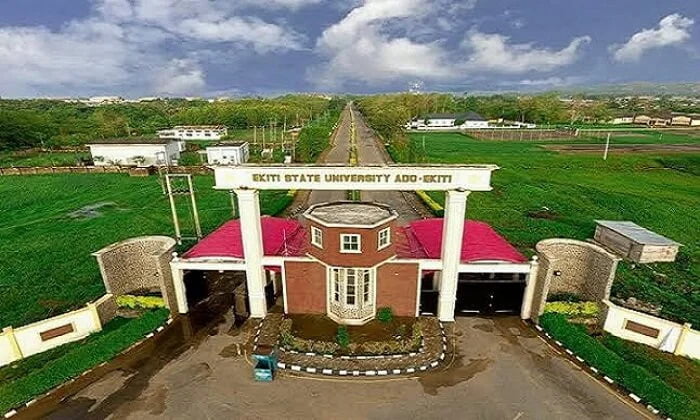
Ekiti State University (EKSU), formerly University of Ado-Ekiti (UNAD), is a state-owned university located in Ado-Ekiti, Ekiti State, Nigeria. Established in 1982, EKSU is one of the leading public universities in South-West Nigeria and is known for academic excellence, affordable education, strong professional programmes, and a stable academic tradition. The university offers undergraduate, postgraduate, diploma, sandwich, JUPEB, and professional programmes across numerous faculties. EKSU operates digital academic and admission systems through its official student portal. (eksu.edu.ng)

The institution is fully recognized by the National Universities Commission (NUC) and attracts students from across Nigeria.

History of the Institution

Ekiti State University was founded in 1982 as Obafemi Awolowo University, Ado-Ekiti by the old Ondo State Government. In 1985, the name changed to Ondo State University. After the creation of Ekiti State in 1996, ownership transferred to the new state government. It was later renamed University of Ado-Ekiti (UNAD) before eventually becoming Ekiti State University (EKSU) in 2011.

Over the decades, EKSU has developed into a comprehensive multi-disciplinary university with strong faculties in sciences, law, medicine, engineering-related fields, arts, education, agriculture, and management sciences. (eksu.edu.ng)

Location

Ado-Ekiti, Ekiti State, Nigeria.
Main Campus located in the state capital, Ado-Ekiti. (eksu.edu.ng)

Faculties / Colleges

EKSU has several faculties including:

  • Faculty of Agriculture
  • Faculty of Arts
  • Faculty of Education
  • Faculty of Engineering
  • Faculty of Law
  • Faculty of Management Sciences
  • Faculty of Science
  • Faculty of Social Sciences
  • Faculty of Basic Medical Sciences
  • Faculty of Clinical Sciences
  • Faculty of Environmental Design & Management
  • College of Medicine (eksu.edu.ng)

List of Courses offered in Ekiti State University

Agriculture

  • Agricultural Economics
  • Animal Production
  • Crop Science
  • Fisheries
  • Forestry

Arts

  • English and Literary Studies
  • French
  • History and International Studies
  • Linguistics
  • Philosophy
  • Religious Studies
  • Theatre Arts

Education

  • Education Biology
  • Education Chemistry
  • Education Mathematics
  • Education English
  • Guidance and Counselling
  • Educational Management

Science

  • Biochemistry
  • Chemistry
  • Computer Science
  • Geology
  • Industrial Chemistry
  • Mathematics
  • Microbiology
  • Physics
  • Statistics
  • Zoology

Social Sciences

  • Economics
  • Geography
  • Political Science
  • Psychology
  • Sociology
  • Criminology / Related Social Courses

Management Sciences

  • Accounting
  • Banking and Finance
  • Business Administration
  • Insurance
  • Marketing

Engineering

  • Civil Engineering
  • Computer Engineering
  • Electrical/Electronics Engineering
  • Mechanical Engineering

Health / Medical Courses

  • Anatomy
  • Medicine and Surgery
  • Medical Laboratory Science
  • Nursing Science
  • Physiology

Law

  • Law (LL.B.)

Admission Requirements

UTME Admission

  • Minimum five O’Level credits including English Language and Mathematics
  • Valid JAMB score
  • Choose EKSU as preferred institution
  • Participate in screening/Post-UTME
  • Upload O’Level results on JAMB CAPS

Direct Entry

  • ND, NCE, JUPEB, IJMB, A-Level or equivalent qualifications accepted.

Cut-Off Mark

General cut-off marks vary yearly. Competitive courses such as Law, Medicine, Nursing, Accounting, and Engineering may require higher scores.

School Fees

EKSU Approved School Fees for New Students 2026/2027

Ekiti State University (EKSU) has released the approved school fees payable by 100 Level and Direct Entry students for the 2026/2027 academic session. The fees vary according to the faculty or programme and whether the student is classified as a resident or non-resident.

The approved school fees range from ₦247,500 to ₦982,500 for residents, while non-resident students are required to pay between ₦322,500 and ₦1,132,500, depending on their programme.

Faculty/Programme Residents (₦) Non-Residents (₦)
Agricultural Sciences – Food Science & Nutrition Technology 357,500 457,500
Agricultural Sciences – Others 357,500 457,500
Arts – French/Theatre & Media Arts 330,000 405,000
Arts – Others 307,500 382,500
Education – Sciences/Geography/French/Vocational Technology 262,500 322,500
Education – Human Kinetics & Health Education 262,500 322,500
Education – Others 247,500 322,500
Engineering 405,500 502,500
Law 607,500 757,500
Management Sciences 307,500 382,500
Multidisciplinary Studies – Mass Communication 375,000 450,000
Multidisciplinary Studies – Others 307,500 382,500
Science – Zoology/Plant Science/Geology/Geophysics 382,500 472,500
Science – SLT (Others) 357,500 457,500
Social Sciences – Geography/THM/EVM/PSY 322,500 397,500
Social Sciences – Others 307,500 382,500
Anatomy/Physiology 532,500 607,000
Nursing Science 607,500 757,500
Medical Laboratory Science 607,500 757,500
Medicine and Surgery 982,500 1,132,500
Pharmacy 800,000 900,000

In addition to the school fees, the university has approved an acceptance fee of ₦112,000 for students admitted into Law, Nursing, Anatomy, Physiology, Surgery and Medicine, while students in other programmes will pay ₦62,000. All students are also required to pay ₦15,000 faculty dues and ₦20,000 Smart School dues. Newly admitted students are advised to take note of the approved charges for their respective programmes and ensure that all required payments are made through the appropriate university channels.

Hostel / Accommodation

Hostel accommodation may be available depending on allocation and available space.

Please check school website or latest news below for newest update.

Official Website and Portal Links

Notable Alumni

EKSU has produced graduates active in politics, academia, media, law, medicine, entrepreneurship, and public service across Nigeria. they include:

  • Biodun Oyebanji – Governor of Ekiti State.
  • Dipo Bamisaye – engineer and former Global President of the EKSU Alumni Association.
  • Oba Ajibade Gbadegesin Ogunoye – Olowo of Owo Kingdom.
  • Tope Fasua – economist and Special Adviser to the President on Economic Affairs.
  • Taofeek Olawale – former Speaker of the Ondo State House of Assembly.
  • Nelson Fashina – professor and former Head of the Department of English at the University of Ibadan.
  • Ganiyu O. Saliu – former Registrar of the University of Ibadan.
  • Chukwuemeka Fred Agbata – technology entrepreneur and media personality.
  • Praise Fowowe – author and motivational speaker.
  • Adetola Juyitan – former President of Junior Chamber International Nigeria.

Frequently Asked Questions (FAQs)

What is EKSU full meaning?
EKSU means Ekiti State University.

What was EKSU formerly called?
It was formerly known as University of Ado-Ekiti (UNAD).

Where is EKSU located?
Ado-Ekiti, Ekiti State, Nigeria.

What is EKSU portal login?
Official portal: https://eksuportal.eksu.edu.ng/login

How can I pay EKSU school fees?
Use the official EKSU student/payment portal.

Does EKSU offer Medicine and Surgery?
Yes, EKSU offers Medicine and Surgery.

Does EKSU offer Law?
Yes, Law is available.

How do I check EKSU admission status?
Use the official admissions and student portal. Please check school website or latest news below for newest update.

AFIT, Kaduna Air Force Institute of Technology
Air Force Institute of Technology, Kaduna – AFIT

The Air Force Institute of Technology, Kaduna (AFIT) is a military and civilian tertiary institution established by the Nigerian Air Force to provide advanced education in engineering, sciences, and aviation-related disciplines.

AFIT was originally founded as a technical training school for Air Force personnel but has since expanded into a full-fledged higher institution offering National Diploma (ND), Higher National Diploma (HND), undergraduate, and postgraduate programmes for both military and civilian students.

The institute is known for its strong focus on aerospace engineering, avionics, and applied sciences, contributing significantly to Nigeria’s aviation and defence sectors.

Location

Air Force Institute of Technology
Kaduna
Kaduna State
Nigeria

Faculties / Schools

AFIT operates several schools and faculties including:

  • School of Air Engineering

  • School of Ground Engineering

  • School of Sciences

  • School of Computing

  • School of Business and Management

  • School of Environmental Technology

List of Courses Offered by Air Force Institute of Technology (AFIT)

Some of the programmes offered include:

  • Aerospace Engineering

  • Mechanical Engineering

  • Electrical/Electronics Engineering

  • Civil Engineering

  • Mechatronics Engineering

  • Computer Science

  • Cyber Security

  • Physics with Electronics

  • Mathematics

  • Statistics

  • Accounting

  • Business Administration

  • Banking and Finance

  • Marketing

  • Estate Management

  • Quantity Surveying

  • Urban and Regional Planning

Admission Requirements

Undergraduate / ND Admission

  • Candidates must sit for the UTME conducted by JAMB.

  • Applicants must obtain at least five O’Level credits, including English Language and Mathematics.

  • Candidates must meet the required JAMB subject combination for their chosen course.

  • Applicants must select AFIT as their preferred institution or apply for a change of institution.

  • Candidates must participate in the Post-UTME screening exercise.

Admissions Portal
https://portal.afit.edu.ng/student/

Direct Entry / HND Admission

  • ND in a relevant field (minimum of Lower Credit for HND).

  • Completion of SIWES/Industrial Training is usually required.

Postgraduate Admission

AFIT offers postgraduate programmes in engineering, sciences, and management fields.

Please check School Website or Latest News Below for updated info.

School Fees

AFIT operates a tuition-free policy, but students pay sundry and administrative charges.

Last known fees include:

  • ND/HND fresh students: approximately ₦109,200 – ₦130,500 depending on programme

  • Degree fresh students: approximately ₦136,300

  • Returning students: approximately ₦52,000 – ₦99,800 depending on level and programme

Acceptance fee is about ₦20,000.

Please check School Website or Latest News Below for updated info.

Cut-off Mark

The last known minimum JAMB cut-off mark is around 140.

Competitive courses such as Engineering and Computer Science may require 150 – 200+.

Please check School Website or Latest News Below for updated info.

Hostel / Accommodation

AFIT provides hostel accommodation within the Nigerian Air Force Base.

Last known hostel fees include:

  • Standard hostel: about ₦25,000 per session

  • Alternative hostels: ₦40,000 – ₦150,000 depending on type and facilities

Accommodation is limited and allocated on a first-come, first-served basis.

Please check School Website or Latest News Below for updated info.

Notice Board

AFIT Resumption Date for 2026/2027 Academic Session

The Air Force Institute of Technology (AFIT) has announced Monday, 19 October 2026 as the resumption date for all undergraduate and Diploma students for the 2026/2027 academic session. Academic activities are expected to commence following the resumption date.

The students’ portal will be open for registration from 19 to 30 October 2026. Students are advised to complete their registration within the stipulated period to avoid the additional charge for late registration.

First-semester lectures are scheduled to begin on Monday, 2 November 2026, which is also the date the mandatory 75 per cent attendance requirement will commence. Late registration will be allowed from 2 to 6 November 2026 at a fee of ₦10,000, while the students’ portal will close for registration on Saturday, 7 November 2026.

Activity Date
Resumption 19 October 2026
Registration 19–30 October 2026
First Semester Lectures 2 November 2026
Late Registration 2–6 November 2026
Late Registration Fee ₦10,000
Portal Closure 7 November 2026

AFIT urged all students to take note of the dates and comply with the registration and attendance requirements for the 2026/2027 academic session.

Notable Alumni

Information on widely recognized notable alumni of AFIT is limited in public sources due to its specialized and military-linked structure.

Please check School Website or Latest News Below for updated info.

Official Website/Login Portal Links

Official Website
https://www.afit.edu.ng/

Student Portal
https://portal.afit.edu.ng/student/

Admissions (Undergraduate)
https://afit.edu.ng/home/admissions/undergraduate/

Admission Requirements
https://afit.edu.ng/home/admissions/admission-requirements/

Admissions Portal
https://admissions.udusok.edu.ng/admin.php

Contact Information

Air Force Institute of Technology
Kaduna
Kaduna State
Nigeria

Phone: Not publicly specified

Email: Not publicly specified

Please check School Website or Latest News Below for updated info.

Frequently Asked Questions (FAQs)

Where is AFIT located?

AFIT is located in Kaduna, Kaduna State, Nigeria, within the Nigerian Air Force Base.

Is AFIT a military school?

AFIT is owned by the Nigerian Air Force, but it admits both military personnel and civilians.

Does AFIT charge tuition fees?

No, tuition is free, but students pay administrative and sundry fees.

Does AFIT conduct Post-UTME screening?

Yes. Candidates must participate in the Post-UTME screening exercise.

What is the cut-off mark for AFIT?

The last known minimum JAMB cut-off mark is around 140, depending on the programme. Please check School Website or Latest News Below for updated info.

Kaduna State College of Education (KSCOE)
Kaduna State College of Education, Gidan Waya – KSCOE

Kaduna State College of Education, Gidan Waya  widely known as KSCOE, KSCOE Gidan Waya, or COEKC  is a state government-owned College of Education located in Gidan Waya, near Kafanchan, Jema’a Local Government Area, Kaduna State, North-West Nigeria. Established in 1977 as the Advanced Teachers’ College, the institution is affiliated with Ahmadu Bello University (ABU) Zaria for its degree programmes. The college is funded and managed by the Kaduna State Government and aims to train students for roles in the education sphere in Nigeria, ranging from teaching to counselling to school management. It has no religious affiliation and admits students irrespective of their cultural background. As of 2022, the College ran more than 29 NCE academic programmes, in addition to undergraduate degree, IJMB, diploma, and certificate programmes. The current Provost is Aku Ambi.

History of the Institution

The College gained autonomy and was no longer directly administered by the State Ministry of Education. It was affiliated to Ahmadu Bello University (ABU) Zaria in 1980. By 1988, the College began the process of movement to its permanent site at Gidan Waya. At present, 80% of the movement has been completed. The Technical and Fine and Applied Arts departments are still at the temporary site in Kafanchan.

In 1998, its name was changed from Advanced Teachers’ College (ATC) to College of Education (COE). Consequent upon the change of name of the institution, the title of the head was changed from Principal to Provost. To provide access to education and training to more people to enable them to qualify for entry into the regular NCE programme and to broaden the scope of training for the beneficiaries from the catchment area, the College introduced Diploma and Certificate programmes in 1998 and IJMB programme in 1999.

Kafanchan Teachers’ College, formerly known as College of Mary Immaculate, became the second campus in 1978. This campus not only has the Technical and Fine and Applied Arts departments, but also served as the original operational base for the College before the movement to Gidan Waya.

The Department of Technical and Commercial Education, now Business Education, came into existence in 1980 on the second campus. The College operated a crash programme which saw three batches of Nigerian Certificate in Education (NCE) students graduating in two years each. This ended in June 1981.

The college has benefited extensively from TETFund annual and special interventions. The Directorate of Undergraduate Studies manages degree programmes affiliated with ABU Zaria, and in February 2026, the Directorate issued important notices to undergraduate students regarding school fees payment deadlines, screening, and collection of examination cards for the 2025/2026 academic session.

Location

Kaduna State College of Education, Gidan Waya (KSCOE) Gidan Waya, Near Kafanchan Jema’a Local Government Area Kaduna State, Nigeria

The college operates two campuses:

  • Main Campus: Gidan Waya, Jema’a LGA, Kaduna State (permanent site)
  • Kafanchan Campus: Kafanchan, Kaduna State (second campus, hosts Technical and Fine and Applied Arts departments)

Please visit the official contact page for current phone and email contact details.

List of Courses Offered by Kaduna State College of Education, Gidan Waya

KSCOE offers NCE, Pre-NCE, IJMB, Undergraduate Degree (ABU-affiliated), and Diploma programmes across multiple schools covering Arts and Social Sciences, Languages, Sciences, Vocational and Technical Education, and Education.

School of Arts and Social Sciences

  • NCE Christian Religious Studies / Social Studies
  • NCE Economics / Social Studies
  • NCE History / Social Studies
  • NCE Geography / Social Studies
  • NCE Civic Education combinations
  • NCE Fine and Applied Arts (Double Major) — housed at Kafanchan Campus
  • NCE Political Science combinations

School of Languages

  • NCE English Language / Hausa
  • NCE English Language / French
  • NCE English Language / Yoruba
  • NCE English Language / Igbo
  • NCE Arabic combinations
  • NCE Hausa / English and other combinations

School of Sciences

  • NCE Mathematics / Physics
  • NCE Mathematics / Computer Science
  • NCE Biology / Chemistry
  • NCE Biology / Agricultural Science
  • NCE Chemistry / Integrated Science
  • NCE Computer Science / Mathematics
  • NCE Integrated Science combinations
  • NCE Home Economics (Double Major)

School of Vocational and Technical Education (Kafanchan Campus)

  • NCE Technical Education (Double Major) — Building Technology, Electrical, Metalwork, Woodwork, Auto Mechanics, Technical Drawing
  • NCE Business Education (Double Major)
  • NCE Agricultural Education (Double Major)

School of Education

  • NCE Guidance and Counselling combinations
  • NCE Educational Foundations combinations

School of Early Childhood Care and Primary Education

  • NCE Early Childhood Care and Education (ECCE)
  • NCE Primary Education Studies (PED)

IJMB Programme

  • Interim Joint Matriculation Board A-Level Programme (established 1999) — a one-year qualification for Direct Entry into universities without re-sitting JAMB

Diploma and Certificate Programmes (established 1998)

  • Various diploma and certificate programmes for candidates seeking foundational teacher training qualifications

Undergraduate Degree Programme (ABU Zaria Affiliated)

  • B.Ed. degree programmes in select disciplines affiliated with Ahmadu Bello University (ABU) Zaria
  • Managed by the Directorate of Undergraduate Studies

For the complete and most up-to-date list of courses, please visit kscoe.edu.ng or see the latest news below.

Admission Requirements

NCE Full-Time Admission

  • A minimum of five (5) O’Level credit passes including English Language, obtained in not more than two sittings in WAEC, NECO, GCE O’Level, or NABTEB.
  • A valid JAMB UTME score of at least 100 is required.
  • Both first-choice and second-choice JAMB candidates may be eligible.
  • All eligible candidates must participate in the KSCOE Post-UTME screening exercise.
  • Candidates awaiting O’Level results may apply.

IJMB Programme Admission

  • A minimum of 5 O’Level credits including English Language and Mathematics, plus relevant science or arts subjects depending on the IJMB combination sought.
  • JAMB is not required for IJMB admission.

Undergraduate Degree Programme (ABU Affiliated)

  • Entry requirements are aligned with Ahmadu Bello University’s standards.
  • NCE holders may apply for Direct Entry into the degree programme.

Apply via: kscoe.edu.ng and the SAF student records system at kscoegw.safrecords.com

Please see the latest news below or visit the school website for the most current admission requirements and deadlines.

School Fees

The college is affordable with tuition subsidised as it is funded by the Kaduna State Government. The Directorate of Undergraduate Studies, Kaduna State College of Education, Gidan Waya, has issued important notices to all undergraduate students regarding the payment of school fees, screening, and collection of examination cards for the 2025/2026 academic session. Students are advised to pay early to avoid late payment penalties and inability to collect examination cards.

The last known school fees for KSCOE Gidan Waya are approximately:

  • NCE Fresh Students (Indigenes): approximately ₦18,000 — ₦35,000 per session
  • NCE Fresh Students (Non-Indigenes): approximately ₦25,000 — ₦50,000 per session
  • NCE Returning Students: lower than fresh student fees
  • Undergraduate Degree Students: slightly higher fee structure, with a deadline-based payment system
  • Acceptance Fee (new students only): approximately ₦5,000 — ₦15,000 (non-refundable)

Fees are paid to designated banks approved by the school management. Students are advised to pay early each session to avoid late payment penalties and to ensure timely access to examination cards and other academic services.

Please see the latest news below or visit the school website for the most current and officially confirmed school fees schedule.

Cut-off Mark

The last known JAMB cut-off mark for KSCOE Gidan Waya is 100 for NCE programmes. Both first-choice and second-choice JAMB candidates who meet the minimum cut-off may apply. For ABU-affiliated degree programmes, the cut-off mark is aligned with ABU Zaria’s admission standards.

Please see the latest news below or visit the school website for the most current cut-off mark information.

Post-UTME / Screening Information

KSCOE Gidan Waya conducts a Post-UTME screening exercise for all eligible JAMB candidates. Candidates must have met the minimum cut-off mark to qualify for the screening. Post-UTME details including dates, fees, and requirements are published on the official website.

Apply / Check Admission: kscoe.edu.ng

SAF Student Records Portal: kscoegw.safrecords.com

Please see the latest news below or visit the school website for the most current Post-UTME dates and requirements.

Hostel / Accommodation

KSCOE Gidan Waya provides on-campus hostel accommodation for students. Accommodation is optional and allocated on a first-come, first-served basis. Students who prefer off-campus options will find affordable housing in the Kafanchan and Gidan Waya areas near the campuses.

Please see the latest news below or visit the school website for the most current hostel fees and accommodation application procedures.

Notice Board

Kaduna State College of Education Teaching Practice Verification 2025/2026

The Kaduna State College of Education (KSCOE), Gidan Waya, has announced the commencement of its Teaching Practice Experience Verification Exercise for the 2025/2026 academic session. Students whose names appear on the attached list are required to report to the Teaching Practice Unit for verification.

The exercise will run from Monday, 19 October, to Monday, 26 October, 2026, between 9:00 a.m. and 2:00 p.m. daily. The venue is the Teaching Practice Unit, Kaduna State College of Education, Gidan Waya.

Affected students are required to bring their Teaching Practice Posting Letters, Teaching Practice Logbooks and evidence of school fee payment. These documents must be presented during the verification exercise.

Students are advised to download and check the attached PDF document to confirm whether their names appear on the list of affected students. All concerned students are expected to comply with the scheduled dates and time and ensure they bring all the required documents for verification.

Kaduna State College of Education Enforces 75% Attendance Rule for Students

The Kaduna State College of Education, Gidan Waya, has directed all students to resume academic activities for the 2026/2027 academic session and comply with the institution’s 75 per cent attendance policy.

The directive was contained in a circular issued by the Directorate of Academic Planning and Monitoring. The college stated that first semester academic activities have commenced, with students expected to attend lectures, practicals, tutorials and other scheduled academic activities.

The institution announced that first semester registration will begin on October 11, 2026, while lectures are scheduled to commence on October 19, 2026. Students are required to maintain a minimum of 75 per cent attendance in lectures, practicals, tutorials and continuous assessments to qualify for examinations.

The college warned that students who fail to meet the attendance requirement in any course will not be allowed to sit for the examination for that course and may be required to carry it over. Other penalties include loss of Continuous Assessment marks and restriction from accessing the school portal for examination card printing and course registration. Academic officers have also been directed to strictly monitor students’ attendance.

Notable Alumni

Please see the latest news below or visit the school website for information on notable alumni of Kaduna State College of Education, Gidan Waya.

Official Website and Portal Links

Resource Link
Official Website kscoe.edu.ng
SAF Student Records Portal kscoegw.safrecords.com
Contact Us kscoe.edu.ng/contact-us
About / History kscoe.edu.ng/about
Facebook Page Kaduna State COE Gidan Waya

Contact Information

Kaduna State College of Education, Gidan Waya (KSCOE) Gidan Waya, Near Kafanchan Jema’a Local Government Area, Kaduna State, Nigeria

Please visit the official contact page for current phone and email contact details.

Frequently Asked Questions (FAQs)

What is the history of Kaduna State College of Education, Gidan Waya? Kaduna State College of Education was established in 1977 as the Advanced Teachers’ College. It was affiliated to Ahmadu Bello University (ABU) Zaria in 1980. By 1988, the College began the process of movement to its permanent site at Gidan Waya. In 1998, its name was changed from Advanced Teachers’ College (ATC) to College of Education (COE). The College introduced Diploma and Certificate programmes in 1998 and IJMB programme in 1999.

Where is Kaduna State College of Education, Gidan Waya located? The college is located in Gidan Waya, near Kafanchan, Jema’a LGA, Kaduna State, North-West Nigeria. It operates a second campus in Kafanchan that houses the Technical Education and Fine and Applied Arts departments.

Is KSCOE Gidan Waya affiliated with any university? Yes. It is affiliated to Ahmadu Bello University (ABU) Zaria for its undergraduate degree programmes.

What is the JAMB cut-off mark for KSCOE? The last known minimum cut-off mark is 100 for NCE programmes. For ABU-affiliated degree programmes, the cut-off is aligned with ABU’s standards.

How much are KSCOE Gidan Waya school fees? Fees range from approximately ₦18,000 — ₦35,000 for indigene NCE students and ₦25,000 — ₦50,000 for non-indigenes per session. The college is affordable, with tuition subsidised by the Kaduna State Government.

How do I check my results or admission list at KSCOE Gidan Waya? Visit the SAF student records portal at kscoegw.safrecords.com or the official website at kscoe.edu.ng to check results and admission status.

How do I log in to the KSCOE Gidan Waya portal? The KSCOE student and records portal is at kscoegw.safrecords.com. Log in using your student credentials. The official college website is at kscoe.edu.ng.

Does KSCOE offer IJMB? Yes. The college introduced the IJMB (Interim Joint Matriculation Board) programme in 1999. IJMB is a one-year A-Level foundation programme that qualifies candidates for Direct Entry into Year 2 at universities without re-sitting JAMB.

Does KSCOE Gidan Waya have hostel accommodation? Yes. On-campus hostel accommodation is available and optional. Accommodation is allocated on a first-come, first-served basis. Please see the latest news below or visit the school website for current hostel fees.


College of Agriculture, Science and Technology, Lafia - COAST
College of Agriculture, Science and Technology, Lafia – COAST

College of Agriculture, Science and Technology, Lafia (COAST), formerly known as College of Agriculture, Lafia, is a state-owned technical institution in Lafia, Nasarawa State, Nigeria. The college has a long history of training manpower in agriculture and has expanded its academic mandate to include applied sciences, management and engineering technology. Its programmes are offered at National Diploma (ND), Higher National Diploma (HND) and preparatory levels.

The institution traces its history to 1977, when it was established as a School of Agriculture under the then Plateau State Government. It was upgraded to a College of Agriculture in 1987 and, following the creation of Nasarawa State in 1996, became the Nasarawa State College of Agriculture, Lafia. The college has subsequently adopted the broader name College of Agriculture, Science and Technology, Lafia to reflect its expanded academic mandate.

Today, COAST Lafia operates seven schools covering agriculture, animal science and fisheries, applied sciences, engineering, environmental technology, management technology, home economics and hospitality management, together with general studies. The college describes its mission as promoting technical knowledge and entrepreneurial education through teaching, research and strategic partnerships for self-reliance.

History of the Institution

College of Agriculture, Science and Technology, Lafia was established in 1977 as a School of Agriculture under the Ministry of Agriculture and Natural Resources of the then Plateau State Government. Its original purpose was to train agricultural assistants and other middle-cadre manpower needed for agricultural development.

At the time, the institution offered two-year training programmes and awarded Diploma certificates in areas such as General Agriculture and Home Economics. Graduates were trained to support agricultural researchers, work as field assistants and participate in agricultural extension activities.

In 1987, the school was elevated to the status of a College of Agriculture through Edict No. 13 of the then Plateau State Government. This development enabled the institution to expand into National Diploma and Higher National Diploma education and brought its technical programmes within the regulatory framework associated with the National Board for Technical Education (NBTE).

The creation of Nasarawa State in October 1996 led to another change in the institution’s legal identity. Its enabling law was re-enacted as Edict No. 15 of 1996, establishing it as the Nasarawa State College of Agriculture, Lafia. Over time, its academic mandate broadened beyond conventional agricultural training to include science, engineering and technology programmes.

The college now describes itself as a polytechnic with a diversified operational framework connecting agriculture with science and engineering. It has seven schools and 24 academic departments, providing a wider range of technical and vocational training than the institution offered during its early years.

Location

College of Agriculture, Science and Technology, Lafia is located in Lafia, Nasarawa State, Nigeria.

The official contact page gives the institutional address as:

P.M.B. 33, Jos Road, Opp. Airport Road, Ombi 2, Lafia, Nasarawa State, Nigeria.

The college’s Lafia location places it within the Nasarawa State capital and provides access to a range of agricultural, scientific and technical learning facilities.

List of Programmes Offered by College of Agriculture, Science and Technology, Lafia

COAST Lafia currently lists the following programmes on its official academic pages.

Higher National Diploma (HND) Programmes

  • HND Agribusiness Management
  • HND Agricultural Extension and Management
  • HND Animal Health Technology
  • HND Animal Production Technology
  • HND Crop Production Technology
  • HND Fisheries Technology
  • HND Home and Rural Economics
  • HND Horticulture and Landscape Technology
  • HND Pest Management Technology
  • HND Post-Harvest Technology

National Diploma (ND) Programmes

  • ND Agricultural and Bio-Environmental Engineering
  • ND Agricultural Technology
  • ND Animal Health and Production Technology
  • ND Civil Engineering
  • ND Computer Engineering
  • ND Computer Science
  • ND Cooperative Economics and Management
  • ND Electrical and Electronic Engineering
  • ND Fashion Design and Clothing Technology
  • ND Fisheries Technology
  • ND Forestry Technology
  • ND Home and Rural Economics
  • ND Horticultural Technology
  • ND Laundry and Dry-Cleaning Technology
  • ND Mechanical Engineering
  • ND Nutrition and Dietetics
  • ND Science Laboratory Technology
  • ND Statistics
  • ND Survey and Geo-Informatics
  • ND Welding and Fabrication Technology

Preparatory Programme

  • Pre-ND Science and Technology

The college’s schools and departments cover areas including Home Economics and Hospitality Management, Management Technology, Applied Sciences and Technology, Agronomy and Environmental Management, Animal Science and Fisheries Technology, Engineering and Environmental Technology, and General Studies.

Admission Requirements

Admission requirements at COAST Lafia vary according to the level and programme being applied for.

ND Admission Requirements

For the 2026/2027 admission exercise, candidates seeking admission into the ND programmes were required to participate in the relevant UTME process and satisfy the college’s programme-specific requirements. Candidates who did not originally select the college were advised to effect a change of institution or course where applicable.

Applicants should possess the relevant O’Level credits for their chosen programme. The exact subject combination can differ between programmes, particularly for engineering, science, agricultural and management courses.

Candidates should therefore check the specific requirements attached to their intended programme before submitting an application rather than relying on a general list of subjects.

HND Admission Requirements

HND applicants are expected to possess a relevant National Diploma qualification and satisfy the entry requirements for the particular HND programme.

The college’s 2026/2027 admission notice included HND programmes such as Agribusiness Management, Agricultural Extension and Management, Crop Production Technology, Pest Management Technology, Horticulture and Landscape Technology, Animal Health Technology, Animal Production Technology, Fisheries Technology, Home and Rural Economics and Agricultural/Bio-Environmental Engineering-related training.

Candidates should confirm the required ND grade, industrial training experience and other departmental conditions before applying.

Pre-ND Admission Requirements

The 2026/2027 Pre-ND Science and Technology programme was open to candidates with at least four relevant credit passes from not more than two sittings.

The published requirements included English Language and Mathematics, together with two other relevant subjects selected from areas such as Chemistry, Biology, Agricultural Science, Food and Nutrition, Home Management, Geography and Economics.

School Fees

A complete and current 2026/2027 school-fee schedule covering all COAST Lafia programmes was not found on the official website during this review.

For accuracy, specific tuition or total-school-fee figures from unofficial websites have not been presented as official charges. Fees may vary according to programme, level and applicable institutional charges.

Prospective students should confirm the current fee schedule through the college or its official admission channels before making payment.

Cut-Off Mark

The 2026/2027 admission information confirms that UTME is part of the admission route for applicable ND programmes. However, the college’s official website does not clearly publish a single current departmental cut-off table covering all programmes.

Some third-party sources report 150 as the general 2026/2027 JAMB minimum, while other reports have referred to lower college-specific thresholds in particular admission notices. Because these figures are not presented consistently, candidates should confirm the applicable score for their intended programme directly with COAST Lafia before relying on it.

A candidate meeting a minimum UTME score should also remember that admission depends on satisfying the other requirements for the selected programme.

Hostel / Accommodation

The college’s official website provides information about its academic facilities and institutional activities, but a current 2026/2027 hostel fee and detailed accommodation schedule were not clearly published on the pages reviewed.

Students who require accommodation should contact the college to confirm whether hostel spaces are available, the applicable charges and the procedure for securing accommodation for the academic session.

Notable Alumni

The official college website does not provide a reliable list of notable alumni with sufficient biographical information for publication.

Rather than attaching names to this section without verification, EducationNGR has left out unconfirmed alumni claims. The college itself states that its graduates have gone into agriculture, engineering, business, public service, teaching and other areas of professional activity.

Official Website and Portal Links

Resource Link
Official Website COAST Lafia Official Website
About the College COAST Lafia About Us
Academic Programmes COAST Lafia Academic Programmes
Contact Page COAST Lafia Contact Page

For admission applications, candidates should use the application route linked from the official college website rather than relying on third-party agents or unofficial websites. The 2026/2027 admission notice specifically directed applicants to the college’s website for registration.

Contact Information

College of Agriculture, Science and Technology, Lafia
P.M.B. 33, Jos Road, Opp. Airport Road, Ombi 2, Lafia, Nasarawa State, Nigeria

Phone:

  • 08130244759
  • 08136668696
  • 080609463344

Email: info@coastlafia.edu.ng

The college’s official administration page currently identifies Dr. Musa Yahya Mai Kafi as the Provost, with Umar Tijjani serving as Registrar.

Frequently Asked Questions (FAQs)

What is the full name of COAST Lafia?

COAST Lafia stands for College of Agriculture, Science and Technology, Lafia. The institution was formerly known as College of Agriculture, Lafia.

Where is College of Agriculture, Science and Technology, Lafia located?

The college is located on Jos Road, Opposite Airport Road, Ombi 2, Lafia, Nasarawa State, Nigeria. Its postal address is P.M.B. 33, Lafia.

When was COAST Lafia established?

The institution was established in 1977 as a School of Agriculture under the then Plateau State Government. It became a College of Agriculture in 1987 and subsequently came under Nasarawa State following the creation of the state in 1996.

What courses does COAST Lafia offer?

COAST Lafia offers ND and HND programmes in areas including agricultural technology, agribusiness, animal health and production, fisheries, engineering, computer science, science laboratory technology, statistics, nutrition and dietetics, fashion design, forestry, horticulture and other technical fields. It also offers Pre-ND Science and Technology.

Does COAST Lafia offer Computer Science?

Yes. ND Computer Science is among the programmes listed by the college. Computer-related training is also available through Computer Engineering and the Department of Computer Science and Information Technology.

Does COAST Lafia offer Engineering?

Yes. The college lists ND programmes in Agricultural and Bio-Environmental Engineering, Civil Engineering, Computer Engineering, Electrical and Electronic Engineering and Mechanical Engineering.

Does COAST Lafia offer HND programmes?

Yes. The college offers HND programmes in areas including Agribusiness Management, Agricultural Extension and Management, Animal Health Technology, Animal Production Technology, Crop Production Technology, Fisheries Technology, Home and Rural Economics, Horticulture and Landscape Technology, Pest Management Technology and Post-Harvest Technology.

What is the 2026/2027 admission application fee?

The published 2026/2027 admission notice stated an application fee of ₦2,000 for the ND/Post-UTME application. The same notice stated ₦6,000 for HND applications, while the separate Pre-ND/Pre-HND notice also reported a ₦6,000 processing fee. Applicants should confirm the applicable charge on the official portal before payment.

When does the 2026/2027 COAST Lafia admission application close?

The published 2026/2027 admission notices stated that the application portal opened on June 8, 2026, with registration scheduled to close on September 30, 2026.

Does COAST Lafia accept JAMB?

Yes. The college’s history explains that its admission process evolved from local entrance examinations to the UTME system conducted by JAMB. The 2026/2027 ND admission exercise also required applicable candidates to participate in UTME.

Can I apply to COAST Lafia if I did not initially choose the college in JAMB?

For the 2026/2027 admission exercise, candidates who had not initially selected the college but wanted to apply were advised to effect a change of institution or course where applicable.

Does COAST Lafia offer Pre-ND?

Yes. The college lists Pre-ND Science and Technology among its programmes, and a separate 2026/2027 admission notice opened applications for the programme.

Who is the current Provost of COAST Lafia?

The college’s official administration page identifies Dr. Musa Yahya Mai Kafi as the Provost.

What is the official website of COAST Lafia?

The official website is coastlafia.edu.ng. Prospective students should use the official website for admission information and avoid paying individuals who claim to process admission on behalf of the college.

How can I contact COAST Lafia?

The college lists 08130244759, 08136668696 and 080609463344 as contact telephone numbers and info@coastlafia.edu.ng as its official email address.

College of Nursing Sciences, Umulogho Obowo - CONSU
College of Nursing Sciences, Umulogho Obowo – CONSU

College of Nursing Sciences, Umulogho Obowo (CONSUO) is a nursing training institution located in Umulogho, Obowo Local Government Area of Imo State, Nigeria. The college is affiliated with Our Lady of Mercy Hospital and is described by its official website as a Catholic institution owned by the Catholic Diocese of Okigwe. Its academic focus is on preparing nurses and midwives through classroom instruction, practical training and clinical experience.

The institution’s core nursing programmes include Basic General Nursing and Basic Midwifery. The official website describes both as three-year programmes leading respectively toward Registered Nurse (RN) and Registered Midwife (RM) professional qualifications. The college also states that students receive hands-on clinical training through partner hospitals and healthcare facilities.

The Nursing and Midwifery Council of Nigeria (NMCN) lists College of Nursing Sciences, Our Lady of Mercy Hospital, Umulogho Obowo with full accreditation for its Nursing Programme and Midwifery Programme, both dated June 2023. The NMCN record gives admission quotas of 120 students for Nursing and 50 students for Midwifery.

History of the Institution

College of Nursing Sciences, Umulogho Obowo developed around the nursing training activities associated with Our Lady of Mercy Hospital in Umulogho, Obowo, Imo State.

The institution’s present identity reflects its development from a hospital-based nursing training establishment into a College of Nursing Sciences offering structured nursing and midwifery education. The college describes itself as a Catholic institution owned by the Catholic Diocese of Okigwe and says it was established in response to the need for qualified nursing professionals in Imo State and beyond.

The college’s training model combines theoretical nursing education with clinical experience. This is particularly important for professional nursing programmes because students must develop practical skills alongside their classroom knowledge.

Its regulatory standing has also developed over time. NMCN records show that the Nursing and Midwifery programmes at the Umulogho institution received full accreditation in June 2023.

Location

College of Nursing Sciences, Umulogho Obowo is located in Umulogho, Obowo Local Government Area, Imo State, Nigeria.

The college’s official contact page lists its address as:

College of Nursing, Umulogho Obowo, Imo State, Nigeria.

The institution is situated within the Obowo area of Imo State and is associated with Our Lady of Mercy Hospital, which provides an important clinical environment for nursing education.

List of Programmes Offered by College of Nursing Sciences, Umulogho Obowo

The college’s current official website identifies the following core programmes:

Nursing Department

  • Basic General Nursing

Midwifery Department

  • Basic Midwifery

The official website describes both programmes as three-year programmes. Basic General Nursing prepares students toward Registered Nurse (RN) training, while Basic Midwifery focuses on maternal, newborn and related midwifery care leading toward Registered Midwife (RM) training.

For the 2026/2027 academic session, the college also advertised an ND Nursing Programme. Candidates interested in this pathway should confirm its current status, structure and entry route directly with the college before applying, particularly because the college’s main programme page currently presents Basic General Nursing and Basic Midwifery as its core programmes.

Admission Requirements

Admission requirements depend on the particular programme and academic session. Applicants should always confirm the requirements for the programme they intend to study before obtaining an admission form.

Basic General Nursing

The college’s nursing training route requires candidates to possess the relevant secondary-school qualifications. The commonly stated requirements include five credit passes in relevant subjects, including:

  • English Language
  • Mathematics
  • Physics
  • Chemistry
  • Biology

The credits should normally be obtained in not more than two sittings.

Applicants should also meet any age, documentation, screening and professional requirements prescribed for the particular admission exercise.

2026/2027 ND Nursing Admission

For the 2026/2027 ND Nursing admission exercise, published admission information stated that candidates needed:

  • A minimum JAMB UTME score of 150.
  • Five credit passes in English Language, Mathematics, Physics, Chemistry and Biology.
  • WAEC, NECO or equivalent O’Level results.
  • A 2026 JAMB UTME result slip.
  • Birth certificate or declaration of age.
  • Testimonial from the last secondary school attended.
  • Three recent passport photographs.
  • Other supporting documents requested by the college.

The published 2026 admission notice also stated that candidates awaiting O’Level results were not eligible for that particular exercise.

School Fees

A complete, current official school-fee schedule for the 2026/2027 academic session was not found on the college’s official website.

Some third-party websites publish estimated figures for the institution, including estimates in the region of ₦150,000–₦200,000 for tuition and registration. However, these figures are not presented here as official current school fees, because the college’s own website instructs prospective students to contact the institution for current fee information.

Prospective students should therefore confirm the complete fee schedule directly from the college before making any payment. They should also ask whether acceptance, registration, clinical, examination, medical, uniform and accommodation charges are included or billed separately.

Cut-Off Mark

For the 2026/2027 ND Nursing admission exercise, the published minimum JAMB score was 150. Candidates were also required to meet the relevant O’Level requirements and participate in the college’s screening process.

This figure should not automatically be treated as a universal cut-off mark for every programme or future admission session. Candidates should check the college’s latest admission notice before applying.

Hostel / Accommodation

The college’s official website states that hostel accommodation is available for qualified female students, while male students currently live outside the school compound.

The current official hostel fee was not published on the college’s website. Students should therefore contact the school to confirm availability, eligibility, payment requirements and the accommodation charge for their particular session.

Notable Alumni

A reliable official list of notable alumni of College of Nursing Sciences, Umulogho Obowo was not identified during the research for this page. Names have therefore not been added without sufficient evidence.

Official Website and Portal Links

Resource Link
Official Website College of Nursing Sciences Umulogho Obowo
About the College About College of Nursing Sciences Umulogho Obowo
Contact Page CONSU Obowo Contact Page
Examination Portal CONSU Examination Portal

The official contact page currently links to the college’s examination portal and provides the institution’s current contact channels.

Contact Information

College of Nursing Sciences, Umulogho Obowo
Umulogho Obowo, Imo State, Nigeria

Office Line: +234 904 065 9343
Dean, Student Affairs: +234 703 770 0397
Email: info@consu.edu.ng
Alternative Email: admin@consu.edu.ng

Students and prospective applicants should use the official contact channels to verify admission dates, fees, programme availability, accommodation and payment information before making financial commitments.

Frequently Asked Questions (FAQs)

Where is College of Nursing Sciences Umulogho Obowo located?

College of Nursing Sciences, Umulogho Obowo is located in Umulogho, Obowo Local Government Area of Imo State, Nigeria.

Is College of Nursing Sciences Umulogho Obowo accredited?

Yes. NMCN records list the Nursing Programme and Midwifery Programme of the College of Nursing Sciences, Our Lady of Mercy Hospital, Umulogho Obowo as having full accreditation dated June 2023.

What courses does College of Nursing Sciences Umulogho Obowo offer?

The college’s official website currently identifies Basic General Nursing and Basic Midwifery as its core programmes. A separate 2026/2027 admission notice also advertised an ND Nursing programme.

How many years is Basic Nursing at Umulogho?

The college describes its Basic General Nursing programme as a three-year programme.

How many years is Basic Midwifery at Umulogho?

The college describes its Basic Midwifery programme as a three-year programme.

What is the 2026/2027 JAMB cut-off mark for College of Nursing Sciences Umulogho?

For the 2026/2027 ND Nursing admission exercise, the published minimum JAMB score was 150. Applicants should confirm the current requirement for their specific programme before applying.

What O’Level subjects are required for Nursing at Umulogho?

The 2026/2027 ND Nursing admission notice required five credits in English Language, Mathematics, Physics, Chemistry and Biology, with the required results obtained in not more than two sittings.

Does College of Nursing Sciences Umulogho accept JAMB?

The 2026/2027 ND Nursing admission exercise required applicants to have a 2026 JAMB UTME result and a minimum score of 150. The admission route can differ between programmes, so applicants should check the current requirements for the programme they want to study.

How much is the College of Nursing Sciences Umulogho admission form?

For the 2026/2027 ND Nursing admission exercise, the reported application/screening charge was ₦30,600. The published notice stated that the form was obtained directly from the school and that there was no online sale or processing of the admission form.

Is hostel accommodation available?

Yes. The college’s official website says hostel accommodation is available for qualified female students, while male students currently live outside the school compound.

How can I contact College of Nursing Sciences Umulogho Obowo?

The official contact page lists +234 904 065 9343 as the office line and +234 703 770 0397 for the Dean of Student Affairs. It also lists info@consu.edu.ng and admin@consu.edu.ng as contact emails.

Who is the Provost of College of Nursing Sciences Umulogho Obowo?

The college’s official website identifies Rev. Sr. Ugochinyere Mbionwu as the Provost.

Benue State College of Health Sciences and Technology, Agasha
Benue State College of Health Sciences and Technology, Agasha – BSCHTA

Benue State College of Health Sciences and Technology, Agasha (BSCHTA) is a state-owned health training institution located in Agasha, Benue State, Nigeria. The college focuses on training students in community health, environmental health, medical laboratory science, pharmacy technology, public health and other health-related fields. Its academic structure currently includes departments such as Community Health, Environmental Health, Medical Laboratory Science, Pharmacy Technician, Public Health, Epidemiology and Disease Control, Basic Science and General Studies.

The institution was established by the Benue State Government in 1992 following the creation of Kogi State and the consequent loss of Benue’s former School of Health Technology. It initially operated temporarily at the State School of Nursing campus in Makurdi before moving to its permanent site in Agasha in September 2006. The college has since developed facilities for classroom teaching, laboratory work, examinations, computing, library services and practical health training.

For prospective students, the college provides an online application and admission portal through which applicants can submit applications and check admission-related information. The 2026/2027 admission exercise included ND, HND and selected top-up programmes, with different application requirements depending on the programme.

History of the Institution

Benue State College of Health Sciences and Technology, Agasha was established in 1992 by the Benue State Government. The establishment followed the creation of Kogi State in 1991, after which Benue State lost its former School of Health Technology as part of the sharing of assets between the two states.

The institution did not immediately begin operations at its present location. It initially operated from the State School of Nursing campus in Makurdi before relocating to its permanent campus at Agasha in September 2006.

According to the college, it began with a modest academic structure but has grown to include eight academic departments. Its stated mandate is centred on education, research and practice in primary healthcare, with emphasis on disease prevention, health promotion and community health development.

The college’s present academic structure reflects this focus, with programmes covering community health, environmental health, public health, epidemiology, medical laboratory training and pharmacy technician education.

Location

Benue State College of Health Sciences and Technology is located in Agasha, Benue State, Nigeria.

The institution’s official contact address is:

P.M.B. 102093, Agasha, Benue State, Nigeria.

Its location outside Makurdi gives the college a campus environment specifically focused on health sciences and technical training. The college states that its permanent site has facilities including classrooms, laboratories, examination halls, computer laboratories, internet facilities and a library.

List of Programmes Offered by Benue State College of Health Sciences and Technology, Agasha

The programmes listed for the college’s 2026/2027 admission exercise include the following:

National Diploma Programmes

  • National Diploma in Community Health
  • National Diploma in Environmental Health Technology
  • National Diploma in Public Health Technology
  • National Diploma in Epidemiology and Disease Control
  • National Diploma in Medical Laboratory Technology
  • National Diploma in Orthopaedic Cast Technology
  • National Diploma in Nutrition and Dietetics
  • National Diploma in Health Education and Promotion

Other Professional and Advanced Programmes

  • Certified Pharmacy Technician
  • Higher National Diploma in Community Health Technology
  • Higher National Diploma in Environmental Health Technology
  • Top-up Programme for ND, HND and BSc Community Health

The 2026/2027 admission information identifies these programmes as part of the college’s admission offerings. The official website also provides individual academic information for areas including Community Health, Public Health, Medical Laboratory Science and Pharmacy Technician training.

Admission Requirements

Admission requirements vary according to the programme, but the college’s general admission guidelines provide a useful starting point for prospective applicants.

General Requirements

For admission into the college, candidates are generally expected to:

  • Be at least 18 years old by September of the year of admission.
  • Possess the required O’Level credits for the intended programme.
  • Have five relevant credit passes, generally including English Language, Mathematics, Biology or Health Science, Chemistry and Physics.
  • Sit for and pass the Unified Tertiary Matriculation Examination (UTME) where required.
  • Participate in the aptitude test conducted by the college.
  • Present original academic certificates for verification after being offered admission.
  • Pay the prescribed school charges and complete student registration after admission.

For the 2026/2027 admission exercise, candidates applying for the first group of ND programmes were required to register for the relevant UTME and select Benue State College of Health Sciences and Technology, Agasha as their institution. HND and top-up applicants were listed separately from the UTME-dependent programmes.

O’Level Requirements

The college generally requires five relevant credit passes in WAEC, NECO, GCE or NABTEB, depending on the programme. For several of its health-related programmes, the required subjects are English Language, Mathematics, Biology, Chemistry and Physics, normally at not more than two sittings.

Applicants should still check the requirements attached to their specific programme before submitting an application because professional health programmes can have additional regulatory or departmental conditions.

School Fees

The college does not currently publish a complete, programme-by-programme 2026/2027 school-fee schedule on the official pages reviewed for this profile. For that reason, a specific tuition figure should not be presented as the current official fee without confirmation from the college.

The Benue State Government’s 2026 budget documents, however, show that the college collects school, tuition, registration and examination-related fees as part of its internally generated revenue.

Prospective students should therefore confirm the current institutional charges through the college before making payment. This is particularly important because fees may differ according to programme, level and other applicable charges.

Cut-Off Mark

A single current institutional cut-off mark for all programmes has not been clearly published on the college’s official website.

The college’s general admission guidelines state that candidates for applicable programmes must sit for and pass UTME, while the 2026/2027 admission information specifies UTME participation and choice of the college for the first group of ND programmes.

Candidates should therefore avoid relying on an unofficial fixed cut-off figure without checking the admission requirements for the particular programme and academic session.

Hostel / Accommodation

The college’s official website confirms that it operates a permanent campus with academic and support facilities, but a current official hostel fee or detailed accommodation schedule was not identified in the sources reviewed.

Students seeking accommodation should contact the college directly to confirm whether hostel spaces are available for their admission year, the applicable charges and the procedure for securing a space.

Notable Alumni

A reliable official list of notable alumni of the Benue State College of Health Sciences and Technology, Agasha was not identified. It would therefore be inappropriate to attach names to this section without sufficient evidence.

The college states that its graduates have gone on to occupy positions within primary healthcare services, reflecting the institution’s long-standing focus on community and public health training.

Official Website and Portal Links

Resource Link
Official Website BSCHTA Official Website
Admission Portal BSCHTA Admission Portal
Admission Guidelines BSCHTA Admission Information
About the College BSCHTA About Page

The official portal provides separate access for applicants and students, including admission-related activities, admission-status checking and student dashboard functions.

Contact Information

Benue State College of Health Sciences and Technology, Agasha
P.M.B. 102093, Agasha, Benue State, Nigeria

Phone: +234 703 865 7585
Email: [email protected]

The contact details above are published on the college’s official website.

Frequently Asked Questions (FAQs)

Is Benue State College of Health Sciences and Technology, Agasha a government-owned institution?

Yes. The college was established by the Benue State Government in 1992 and operates as a state-owned health training institution.

Where is Benue State College of Health Sciences and Technology located?

The college is located in Agasha, Benue State, Nigeria, with its official postal address listed as P.M.B. 102093, Agasha, Benue State.

What courses does BSCHT Agasha offer?

The college offers programmes in areas including Community Health, Environmental Health Technology, Public Health Technology, Epidemiology and Disease Control, Medical Laboratory Technology, Pharmacy Technician training, Orthopaedic Cast Technology, Nutrition and Dietetics, Health Education and Promotion, as well as selected HND and top-up programmes.

Does BSCHT Agasha require JAMB?

JAMB requirements depend on the programme. For the 2026/2027 admission exercise, applicants for the first nine listed ND programmes were required to sit for the relevant UTME and choose the college on the JAMB portal. The published admission information separately listed HND and top-up programmes that did not require UTME.

What are the O’Level requirements for BSCHT Agasha?

The general requirement is five relevant O’Level credit passes, generally including English Language, Mathematics, Biology or Health Science, Chemistry and Physics. Individual programmes may have specific requirements.

How old must an applicant be?

The college’s general admission guidelines state that applicants should have attained 18 years of age by September of the year of admission.

How can I apply to Benue State College of Health Sciences and Technology, Agasha?

Applications are made through the college’s online portal. Applicants should first read the admission guidelines, create an application through the portal and follow the payment and submission instructions provided there.

How much is the BSCHT Agasha admission form?

For the 2026/2027 admission exercise, published admission information reported application-form charges of ₦10,000 for ND, ₦15,000 for HND and ₦25,000 for top-up programmes. Applicants should verify that these charges still apply before payment because admission fees can change between sessions.

Who is the current Provost of BSCHT Agasha?

The college’s official website identifies Dr. Daniel Vershima Zar as the Provost of Benue State College of Health Sciences and Technology, Agasha.

Does the college offer Medical Laboratory Technology?

Yes. The college’s Medical Laboratory Science Department offers a Medical Laboratory Technician (MLT) programme described by the institution as a three-year full-time programme with practical laboratory training.

Does the college offer Public Health?

Yes. The Public Health Department offers a National Diploma in Public Health Technology, structured as a two-year programme with classroom, laboratory and field-practical components, including SIWES.

Does the college offer Pharmacy Technician training?

Yes. The Pharmacy Technician Department offers a three-year Pharmacy Technician programme combining classroom instruction, practical hospital and community-pharmacy training and laboratory work.

Is the college’s current school-fee schedule available online?

A complete current 2026/2027 fee schedule was not found on the official pages reviewed. Students should confirm the applicable fees directly from the college or through the official portal before making payment.