
I registered a cousin for the UTME last year while she was studying in Cotonou, and the question that came up first wasn’t about subjects or the e-PIN. It was about where she’d actually sit the exam, since her home state is Edo but she hadn’t set foot there in two years. That mix-up is more common than JAMB’s own guidance pages let on, because most of what’s written about exam centres assumes you’re registering in the same town you grew up in.
Key takeaways
- Your exam centre is tied to the town or country you pick during registration, not your state of origin on your biodata.
- JAMB groups centres into examination towns, then spreads candidates across those centres at random once you’ve picked a town.
- Ten foreign cities currently host registration and the exam itself for candidates abroad, and the fee there is paid in US dollars or the local equivalent.
- Once your town choice locks in at the close of registration, you cannot switch states, towns, or countries afterward.
- A full town can quietly push you into a “group of towns,” meaning you might land in a neighbouring town you never typed into the form.
The one thing that actually decides your centre: where you register, not where you’re from
JAMB’s whole centre system runs on a single input: the examination town you select on the registration portal. That’s it. Your state of origin, the one tied to your NIN and shown on your slip, plays no part in this. It exists for catchment area and admission quota purposes, completely separate from exam logistics.
So if you’re an Edo-born candidate registering in Lagos because that’s where you’re in school, your exam centre comes from the Lagos town pool, not an Edo one. JAMB’s own Registrar has said as much directly: the board does not transfer candidates to a town they didn’t pick, and it doesn’t pull anyone into their state of origin’s town either. The system reads your registration location, not your bloodline.
This matters because a lot of candidates assume the opposite. They think JAMB will somehow “know” they’re from Anambra and route them home for the exam. It won’t. If you sit your registration in Port Harcourt, you stay in the Port Harcourt town pool unless you tell the form otherwise.
Why this trips people up
Parents and guardians are usually the ones who get this wrong, not the candidates. A parent registers their child at a CBT centre near the family’s current address (say, where dad works in Kano) while the family still thinks of itself as “from” Sokoto. They assume the system will sort it out by state. It won’t. The exam town field on the form is the only lever that controls where the candidate sits, and whoever fills that form has to type the actual intended exam location, not the ancestral one.
How JAMB actually assigns you to a centre once you’ve picked a town

Picking a town doesn’t hand you a specific CBT centre. It hands you a place in a pool. Here’s the mechanic, broken into the order it actually happens.
- You select an examination town during registration. This can be a single town or, in some cases, a listed group of towns.
- JAMB checks that town’s available capacity. Each town has a finite number of accredited CBT centres and a finite number of seats across them.
- If there’s room, your registration locks to that town. If the town is full, the system won’t let you pick it, and you have to choose from what’s still open.
- Closer to the exam date, JAMB’s internal system randomly distributes candidates from the town pool into specific centres within that town. The Registrar has described this as an automated process built specifically to remove human bias from which centre a candidate lands in.
- Your exact centre, address, and reporting time appear only when slip printing opens, a window that typically sits in the days just before the exam, not at the point of registration.
That gap between steps 3 and 5 is where most of the anxiety comes from. You commit to a town in January or February, and you don’t find out your actual building until April. There’s no way to check it earlier because the centre-level assignment genuinely hasn’t happened yet.
What “group of towns” actually means for you
Some areas don’t have enough standalone centres to stand alone as their own pool. JAMB merges smaller towns into a combined group instead. If you pick a grouped option, you’re agreeing to sit anywhere within that group, not just the specific town you may have had in mind when you clicked.
This came about partly because some single-centre towns saw collusion problems between candidates and centre staff, so JAMB folded thin-capacity towns into wider groups to dilute that risk. If you’re registering somewhere rural or in a smaller town, check whether your “town” option is actually a group before you commit. A different town within the same group can be an hour or more away from where you expected.
The out-of-state registration decision: a quick scoring check
Before you register away from your home area, run through this. I’m calling it the Away-From-Home Centre Check, and it’s built around hard thresholds rather than vague advice.
- Travel cost on exam day: if getting to your chosen town and back costs more than a day’s wage for your household, that’s a real constraint, not a minor one. Price it before you register, not after.
- Distance from your current residence: if your chosen town is more than two hours away from where you’ll actually be living on exam day, you’re betting on transport working perfectly on one specific morning. Pick closer if you can.
- Town capacity history: smaller towns fill up fast. If you’re registering in the final week before the deadline, lean toward a town you know has multiple centres, since single-centre towns close out first.
- Group-of-towns risk: if your state has merged towns into groups this cycle, treat your “chosen town” as a guess, not a guarantee, and prepare mentally for a neighbouring town instead.
- Documentation mismatch: if your school records, NIN address, and current residence are all in different states, decide now which one the registration form should reflect, since you can’t quietly fix this after the fact.
Score yourself honestly on each line. If you fail two or more, it’s worth rethinking the town you’re about to lock in, because the system gives you exactly one shot at this choice.
Registering from outside Nigeria: the foreign centre system
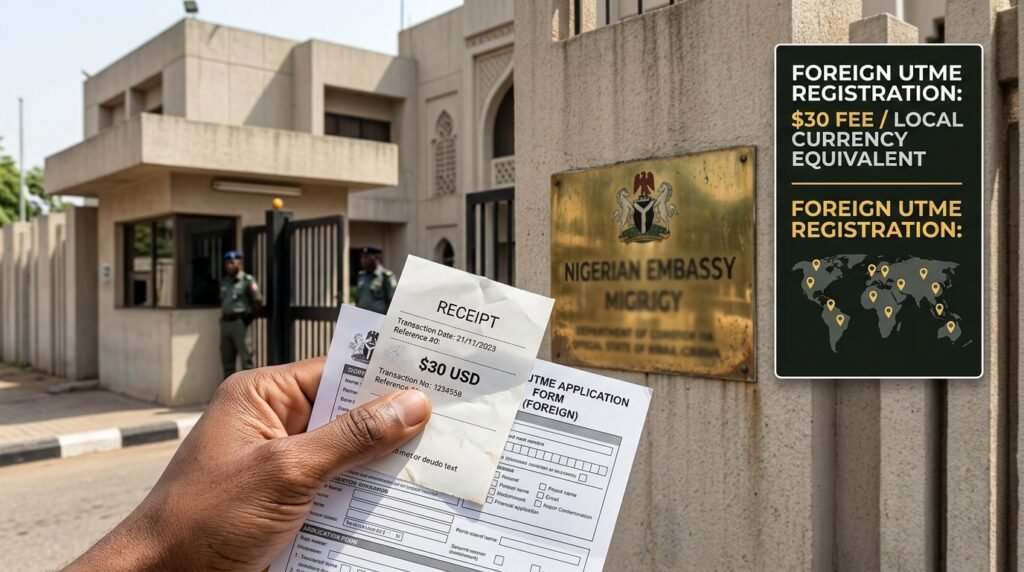
Candidates living abroad don’t pick a Nigerian town at all. JAMB instead runs registration and the exam itself through a fixed set of overseas cities, almost always inside the Nigerian embassy or consulate in that country.
For the 2026 cycle, JAMB listed ten foreign cities as approved registration and exam locations: Abidjan, Accra, Banjul, Beau, Cotonou, Jeddah, Johannesburg, London, Malabo, and Ouagadougou. The Nigerian Missions, meaning the embassies, in each of these cities can be contacted directly for guidance on both the registration process and the exam itself.
The number on this list moves year to year. In 2025, only seven cities ran the foreign exam: Buea in Cameroon, Jeddah in Saudi Arabia, London in the United Kingdom, Johannesburg in South Africa, Lome in Togo, Cotonou in Benin Republic, and Accra in Ghana. In 2024 it ran across eight, adding Abidjan and Banjul to a similar core list. So if you’re abroad, don’t assume last year’s list is this year’s list. Check the current bulletin on JAMB’s own site before you plan around a specific city.
Foreign centre fees and what they cover
The registration fee for candidates registering from the foreign centres is thirty US dollars per country, or the local currency equivalent. That’s separate from, and in addition to, the standard naira-based ePIN cost candidates pay inside Nigeria. Some reporting from earlier in the 2026 cycle quoted fifty dollars instead of thirty, so treat the exact figure as something to confirm directly with the embassy or JAMB’s current portal rather than locking it in from memory, since these figures get revised between announcements.
How foreign centre allocation differs from domestic allocation
| Factor | Domestic (inside Nigeria) | Foreign (outside Nigeria) |
|---|---|---|
| What you choose at registration | A specific Nigerian town or town group | A specific foreign city from the approved list |
| Where you physically register | Any accredited CBT centre in your area | The Nigerian embassy or consulate in that city, or a designated centre there |
| Currency | Naira, paid through the ePIN system | US dollars or the host country’s local currency |
| Centre-level assignment | Random distribution among multiple centres within the town | Usually one fixed venue per city (the mission or its designated centre) |
| Can the city change mid-cycle? | Towns can be merged into groups for capacity reasons | The list of approved cities itself can change between exam cycles |
The big practical difference: domestic candidates wait for an internal lottery among several centres in their town. Foreign candidates generally know their venue earlier, because most listed cities run on one designated site tied to the embassy, so there’s less of the “which building will I get” uncertainty that domestic candidates deal with.
If your country isn’t on the list
Not every country with Nigerian residents gets a centre. If you live somewhere outside the approved list, your practical options are to travel to the nearest listed city for that cycle, or to register and sit the exam inside Nigeria during a visit home. There isn’t a remote or online sitting option for UTME itself. Reach out to the Nigerian mission nearest you first, since some missions coordinate informally with neighbouring approved cities for candidates who’d otherwise have no nearby option.
What you cannot change once you’ve registered
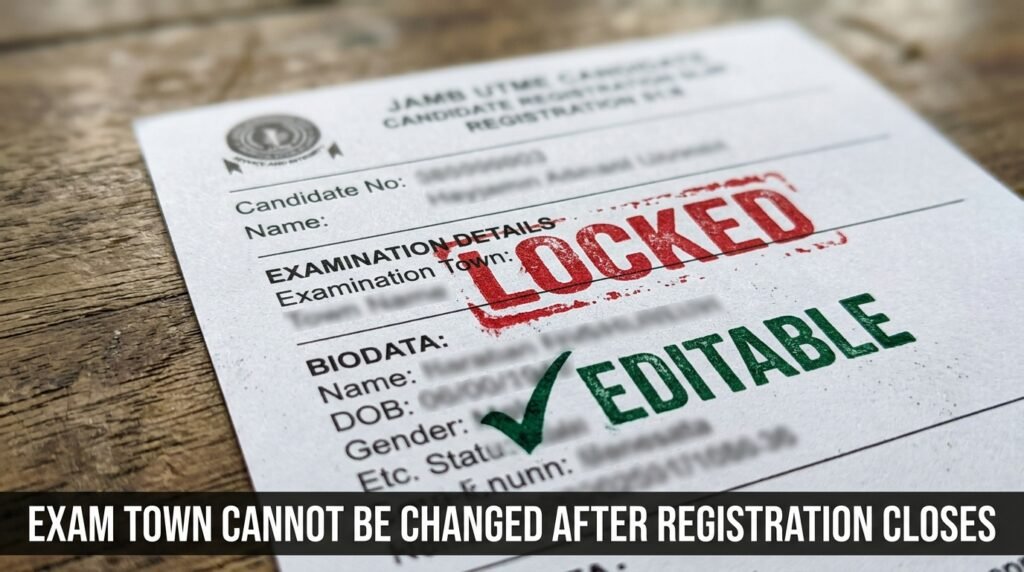
This is the part that catches people off guard the hardest, so I want to be blunt about it rather than soften it.
You cannot change your exam state, town, or country after registration closes. Not for a fee, not through an agent, not by complaint. JAMB’s own registration documents state plainly that the board will not post a candidate to any town or group of towns other than the one chosen at registration. The only things you can correct afterward through the official data correction process are biodata items such as name spelling, date of birth, or state of origin, and those go through JAMB’s e-Facility correction service for a fee, separate entirely from your exam location.
What you can still do:
- Correct biodata errors (name, date of birth, state of origin, gender) through JAMB’s official correction channel before the relevant deadline.
- Check and reprint your exam slip as many times as needed once printing opens, to confirm your assigned centre, date, and time.
- Contact JAMB directly, or the embassy if you’re abroad, if your slip shows an error that genuinely came from JAMB’s system rather than your own input.
What you cannot do:
- Move from one state or country to another after the registration window shuts.
- Pick a specific CBT centre by name; you only ever pick a town or city, never the exact building.
- Pay anyone, including centre staff, to “guarantee” a particular centre. JAMB has repeatedly warned that this kind of arrangement is the thing its random distribution system was built to prevent.
Common mistakes candidates make with cross-state and foreign registration
I’ve seen a few patterns repeat often enough that they’re worth naming directly, since generic “register early” advice doesn’t address any of these.
Registering in a town you don’t actually plan to be in on exam day. This happens when someone registers during a school holiday in their hometown but plans to be back in their school’s city by April. The town is locked at registration, not at exam time. If you’ll have moved by exam week, register in the town you’ll be in then, not the one you’re in now.
Assuming a foreign city listed last cycle is automatically listed this cycle. The foreign centre list isn’t fixed by law; it’s an operational decision JAMB renews or revises each cycle based on demand and logistics. Cities have been added and dropped across recent cycles. Confirm the current list before telling anyone abroad to plan around a specific embassy.
Confusing your registration centre with your exam centre. The CBT centre where you sit to do your biometric capture and complete registration is not necessarily where you’ll write the exam. Registration centres handle data entry. Exam centres get assigned afterward from the wider town pool, and they can be a completely different building.
Waiting until the final days to register in a small town. Smaller towns and grouped towns have thin capacity. Late registrants in those areas frequently find their first-choice town already full and get pushed into a group-of-towns option they didn’t plan for. Registering in the first half of the window protects your actual first choice.
Believing a “connection” at a CBT centre can fix the centre assignment. The randomisation step exists specifically because this kind of arrangement used to happen. Anyone offering to guarantee you a specific centre for a fee is not describing how the system works.
A short FAQ on edge cases
Can I register in Nigeria but ask to sit the exam at a foreign centre, or the reverse? No. Your registration location and your exam town selection happen in the same session, on the same form, and they’re tied together. You can’t register inside Nigeria and then request a foreign sitting, or vice versa.
If I’m a Nigerian studying abroad in a country with no listed foreign centre, can I still register through Nigeria remotely? There’s no remote registration path. You’d need to either travel to a country on the approved list for that cycle or come to Nigeria to register and sit the exam at a domestic centre.
Does my state of origin affect which foreign city I’m allowed to use? No. Foreign centre choice depends only on which country or city you’re physically registering in, not your Nigerian state of origin. The two pieces of information serve completely different purposes on your record.
What happens if the foreign city I registered in gets dropped from the list before the exam? This is rare but not impossible given how the list shifts between cycles. If it happens, JAMB and the relevant embassy would need to communicate an alternative directly to affected candidates. There isn’t a standard published fallback procedure for this scenario, so candidates abroad should keep an eye on announcements from their specific mission as exam dates approach, rather than assuming silence means nothing has changed.
If you’re registering away from home this cycle, lock in the town or city you’ll genuinely be in on exam day, register inside the first half of the window so a fuller pool doesn’t push you into a group you didn’t choose, and confirm the current foreign centre list directly with JAMB or your nearest embassy rather than relying on what last year’s candidates told you.
Discover more from EducationNGR
Subscribe to get the latest posts sent to your email.