
I printed my mock slip back in March and did the thing almost every candidate does. I looked at the centre name, mentally filed it away as “my exam venue,” and moved on to revising. Then the main UTME slip came out in April, and the centre was a completely different address, a 25-minute bus ride from where I sat the mock. That mismatch is what pushed me to actually dig into how JAMB builds these two allocations, and the short answer is: they are not connected the way most guides imply.
If you registered for the optional mock and you’re now wondering whether your mock venue gives you any clue about your main exam venue, the answer is no, not reliably. JAMB runs two separate allocation exercises, weeks apart, using different candidate pools and different centre lists at the time each one runs. Your mock slip confirms exactly one thing: where you sat the mock, on its date. It doesn’t confirm or predict where you’ll sit the real UTME.
Key takeaways
- The mock centre and the UTME centre come from two separate allocation runs, not one continuous booking.
- A shared registration number does not mean a shared venue. JAMB reassigns candidates to centres each time it builds a sitting.
- Centre lists change between the mock and the main exam. JAMB delisted CBT centres after the 2026 mock over technical problems, which forced fresh assignments for anyone affected.
- Your exam town (the city or area you picked at registration) usually stays fixed, but the exact centre inside that town can and often does change.
- The only document that confirms your real centre is the slip for that specific sitting, printed close to that sitting’s date.
Why people assume the mock centre carries over (and why that’s wrong)
Most guides on this topic repeat the same instruction: “check your slip and go to the centre it shows.” That’s true, but it skips the part candidates actually want to know, which is whether the mock slip and the UTME slip show the same place. They often don’t, and the reason comes down to how JAMB builds each allocation.
Here’s the part that gets missed. The mock and the UTME aren’t one exam with two checkpoints. They’re two separate examinations, registered as two separate intentions, scheduled on two separate dates, and assigned through two separate centre-allocation runs. When JAMB opens slip printing for the mock, it pulls the list of candidates who selected the mock option and slots them into available CBT centres within their chosen exam town. The exact centre is determined by JAMB, and candidates can’t manually choose or change it. Weeks later, when JAMB builds the UTME allocation, it runs that same kind of process again, from scratch, using the list of all UTME candidates (mock or no mock) and whatever centres are active and have capacity at that point.
Nothing about the first run feeds into the second one. Your registration number stays the same. Your exam town preference usually stays the same. But the centre slot you land in in March has no bearing on the slot you land in come April.
How the two allocations are actually produced

It helps to picture this as two different bookings rather than one continuous process. Here’s a side-by-side look at what’s different and what stays the same.
| Factor | Mock allocation | UTME allocation |
|---|---|---|
| Who’s included | Only candidates who selected the mock option and met the registration deadline (16 February 2026 for the 2026 cycle) | Every registered UTME candidate, mock or not |
| When it’s built | Shortly before the mock date | Shortly before the main exam window |
| Centre pool used | Centres active and accredited at that point in the cycle | Centres active and accredited at that later point, which can have changed |
| Basis for placement | Exam town selected at registration, plus available accredited centres and centre capacity in that town | Same basis, but recalculated against the current centre list and candidate volume |
| Where it’s confirmed | Mock exam slip, printed from the mock slip portal | Main UTME exam slip, printed from the official slip printing portal |
| What a mismatch means | Nothing wrong has happened. This is the normal outcome | N/A, this is the binding allocation for the real exam |
Look at the “centre pool used” row. That’s the detail most explanations skip, and it’s the actual mechanism behind why your venue can shift.
The concrete reason the venues commonly differ
This isn’t a vague “things change” explanation. There’s a specific, documented reason the centre list itself moves between the two sittings.
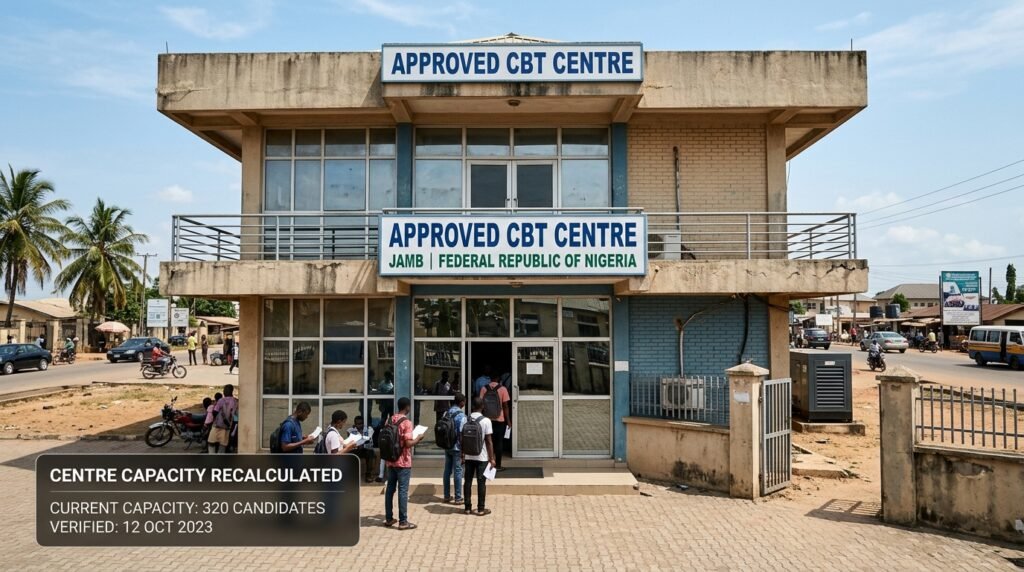
After the 2026 mock exam ran on 28 March, JAMB’s spokesperson announced that the board had delisted 20 CBT centres over technical inaccuracies that disrupted the exam in parts of the country. Out of roughly 224,597 candidates who registered for the mock, about 152,586 actually sat it, across 989 centres nationwide. Any candidate whose mock centre was one of those 20 delisted venues was, by definition, going to get a different centre for the main UTME, because that venue was no longer in the pool at all.
That’s the clearest case, but it’s not the only reason allocations shift. A few other things move between the mock and the main exam:
- Candidate volume changes. The mock pool is smaller than the full UTME pool, since only candidates who opted in and paid the mock fee take part. A centre that comfortably held mock candidates from one town might hit its capacity limit once the full UTME population in that town needs seats.
- Centre capacity gets reallocated. Each accredited CBT centre has a fixed candidate limit per session, and popular centres in major towns fill up fast. JAMB rebalances who goes where based on that capacity at the time it builds each sitting, not based on where you sat last time.
- New centres get accredited or centres get suspended. The list of accredited centres isn’t frozen for the whole admission cycle. Centres can be added, paused, or removed between March and April, and the allocation that runs in April only draws from whatever’s active then.
- Your exam town usually doesn’t change, but it isn’t a guarantee either. JAMB assigns you a centre within the town you selected, based on availability, and once assigned you generally can’t change your exam state or centre yourself. The town preference is sticky. The specific centre inside it is not.
None of this means your mock allocation was wrong, or that something went sideways with your registration. It means the two exams draw from different snapshots of the same system.
What your mock slip actually confirms (and what it doesn’t)
It’s worth being precise about what that mock slip is good for, because it’s not nothing.
What the mock slip tells you:
- That you’re registered and your mock fee or option was processed correctly.
- The exact centre, date, and time for the mock sitting only.
- What a real JAMB exam slip looks like, so you know what to check for when the UTME slip appears.
- Whether the CBT environment, the navigation, the timing pressure, feels manageable to you before the exam that counts.
What the mock slip does not tell you:
- Your UTME centre.
- Your UTME date or session time.
- Whether your UTME town will have the same centres available.
- Anything about your eventual UTME performance. The mock score has no effect on your UTME result. It exists purely for preparation.
If you walked away from the mock thinking “okay, that’s my exam centre sorted,” the only safe move now is to treat that as settled information about March and nothing about April.
The mock-to-UTME centre check: a simple decision tool
Here’s a short checklist I’d actually use once your real UTME slip becomes available, instead of assuming continuity from the mock.
- Did you take the mock at all? If no, skip straight to step 4. There’s no mock centre to compare anyway.
- Has the official UTME slip printing window opened yet? If no, stop here. Don’t act on the mock centre as if it’s final. Wait for the actual slip.
- Once your UTME slip is out, pull both slips side by side. Compare centre name, full address, date, and session time. Don’t compare from memory.
- If the centre name matches: good, but still verify the full address and travel route, since centre names can occasionally repeat across different addresses in busy towns.
- If the centre name is different: this is the normal outcome, not an error. Note the new address, check how to get there, and plan your travel time around the new location, not the old one.
- If your exam town itself changed: that’s rarer and worth flagging to JAMB through its official support channels, since town changes after registration are not something you can request yourself.
Call this your slip-comparison check. It takes two minutes and it’s the one step most candidates skip because they assume the mock slip already answered the question.
Common mistakes candidates make with this
A few patterns show up again and again around this exact confusion.
- Assuming the mock centre is locked in. This is the core mistake the search intent here is built around, and it’s the one worth repeating: treating the mock venue as a preview of the real one, then showing up to the wrong building on UTME day because nobody checked the new slip.
- Not reprinting the slip close to the exam date. Slip details, including the centre, are only reliable when checked close to the actual sitting. Reprinting early and then never checking again means you might miss a late centre change, like the kind triggered by the 20 delisted centres after the 2026 mock.
- Relying on word of mouth instead of the portal. Friends comparing notes in a WhatsApp group will tell you their centre, not yours. Centre assignment is individual, even for candidates in the same town.
- Assuming a delisted centre notice doesn’t apply to them. If your mock centre was on the delisted list, your existing mock slip is no longer a useful reference point at all. Check the official update directly rather than guessing.
- Confusing the registration centre with the exam centre. Your registration centre is the accredited CBT centre or office where you completed registration, while your examination centre is the venue where you actually sit the exam. These are frequently two different places even within a single sitting, let alone across the mock and the UTME.
What to actually check before exam day
Skip the guesswork and go straight to the source for both sittings.
- For the mock (if you sat one): the mock slip you already printed is your record of that day. Keep it for personal reference, but don’t carry its centre forward in your planning.
- For the main UTME: wait for JAMB’s official slip printing window to open, then print or reprint your slip directly from JAMB’s slip printing portal using your registration number. Check the centre name, the full address, the date, and the reporting time every time you print, even if you printed once before.
- If a centre delisting or reassignment notice is issued: treat it as the latest source of truth and reprint your slip again afterward, since the slip itself should reflect any reassignment.
If your UTME centre comes back different from your mock centre, that’s not a sign of a mistake on your registration or a system error. It’s just how JAMB builds these two allocations: separately, on separate timelines, against whatever centre capacity exists at each point. Print the slip that matches the exam you’re actually about to sit, check the full address against a map before exam day, and plan your travel time around that one, not the one you remember from March.
Discover more from EducationNGR
Subscribe to get the latest posts sent to your email.