Federal Governemnt of Nigeria FG
FG Launches Learner Identification Number (LIN) For Students Nationwide

The Federal Ministry of Education Nigeria has introduced a nationwide Learner Identification Number (LIN), a digital system designed to give every student a permanent academic identity across all levels of education.

The initiative aims to strengthen learning continuity, improve educational planning, and support timely interventions within the system. EducationNGR gathered that the rollout marks a significant shift towards data-driven school administration on a national scale.

What The Learner Identification Number Means

The Learner Identification Number assigns each student a unique and permanent academic identity.

This system will:

  • Track a learner’s academic journey from basic to higher education
  • Provide accurate and centralised student records
  • Support better policy planning and implementation

With a unified identity, education authorities can monitor progression and respond more effectively to emerging challenges.

What The Minister Said About The LIN Launch

The Honourable Minister of Education, Maruf Tunji Alausa, described the initiative as a major milestone aligned with the Renewed Hope Agenda of Bola Ahmed Tinubu.

According to the Minister:

  • The LIN initiative focuses on human capital development
  • It promotes technology-driven reforms in the education sector
  • It strengthens transparency and accountability in school administration

First Phase Of The Rollout

The initial phase of the rollout has already covered over 1.9 million candidates sitting for the 2026 examinations conducted by:

  • West African Examinations Council
  • National Examinations Council

This phase establishes an early nationwide database through major examination bodies, improving both examination integrity and student data management.

How LIN Works With DNEMIS

The LIN system is integrated with the Digitised National Education Management Information System (DNEMIS).

DNEMIS:

  • Maintains a national register of schools
  • Links students to verified institutional records
  • Creates a structured and reliable education database

This integration ensures consistency and accuracy in both learner and school data nationwide.

What The System Is Set To Improve

The Federal Ministry of Education highlighted several key benefits of the LIN system:

  • Improved examination security and reduced impersonation
  • Better tracking of out-of-school children and dropouts
  • Early identification of learning gaps
  • Faster and more effective government intervention

These improvements are expected to enhance overall education quality and accountability.

Next Step For Public And Private Schools

The Ministry has announced plans to expand the system across all public and private schools in Nigeria.

Stakeholders are encouraged to support full implementation as part of efforts to build:

  • A transparent education system
  • An inclusive learning environment
  • A reliable national education database

The government reaffirmed its commitment to modernising education through digital innovation and structured data systems.

Summary Table Of Key Details

Item Details
Initiative Learner Identification Number (LIN)
Launched By Federal Ministry of Education Nigeria
Purpose Permanent student academic identity
First Phase Coverage 1.9 million candidates
Exam Bodies Involved WAEC, NECO
Supporting System DNEMIS
Key Benefits Data tracking, exam security, policy planning
Next Step Nationwide rollout in public and private schools
Federal Governemnt of Nigeria FG
Sokoto State Scholarship Form Collection Schedule 2025/2026

The Sokoto State Scholarship Board has announced the commencement of scholarship application form collection for indigenes of Sokoto State studying in selected institutions for the 2025/2026 academic session.

The exercise is scheduled to take place at Block 17, Shehu Kangiwa Secretariat, starting 8:00 am prompt on assigned dates for each institution.

Scholarship Form Collection Schedule By School

The Board has organised the exercise based on institutions, assigning specific dates to each.

Usmanu Danfodiyo University Sokoto

  • Monday, 23 March – Saturday, 28 March 2026

Shehu Shagari College of Education

  • Monday, 30 March – Saturday, 4 April 2026

Sokoto State University

  • Monday, 6 April – Saturday, 11 April 2026

Shehu Shagari University of Education

  • Monday, 13 April – Saturday, 18 April 2026

Venue And Reporting Time

  • Venue: Sokoto State Scholarship Board, Block 17, Shehu Kangiwa Secretariat
  • Time: 8:00 am prompt daily

Students are expected to strictly adhere to the date assigned to their institution.

Documents Required For Submission

Applicants must submit their completed forms alongside the following:

  • Completed scholarship application form
  • Original and photocopies of all credentials
  • Indigene letter
  • Confirmation of admission
  • NIN slip
  • Invoice and Remita (or proof of payment of registration fees)

Who The Notice Covers

This notice applies to:

  • Prospective candidates
  • Continuing students
  • Indigenes of Sokoto State studying in the listed institutions

What Students Should Note

  • Each institution has a specific date window, and applicants must follow it strictly.
  • The venue and time remain fixed for all candidates.
  • Ensure all required documents are complete to avoid delays.

EducationNGR also gathered that students who prepare their documents ahead of time are more likely to complete the process smoothly without unnecessary setbacks.

Summary Of Key Details

Item Details
Academic Session 2025/2026
Start Date 23 March 2026
End Date 18 April 2026
Venue Sokoto State Scholarship Board, Block 17 Shehu Kangiwa Secretariat
Time 8:00 am prompt
Eligible Applicants Sokoto State indigenes (prospective & continuing students)
Requirement Highlights Application form, credentials, indigene letter, NIN, payment proof
Federal Governemnt of Nigeria FG
Delta State Registration For Tertiary Institutions Entrepreneurship 2026

The Delta State Government has announced the commencement of registration for the Tertiary Institutions Entrepreneurship Programme (TEP), a scheme designed to support students of state-owned universities with viable business ideas.

The programme targets eligible undergraduates and is aimed at promoting entrepreneurship and self-reliance among students in Delta State.

Registration Start Date

Registration for the programme officially opens on 2 February 2026. Eligible students are required to complete their applications online and ensure that all information and supporting documents are correctly submitted.

EducationNGR also learnt that only applications with complete and verifiable details will be considered during the screening process.

Where To Apply

Applications are to be submitted through the official TEP application portal. The same platform will be used for document uploads and subsequent updates related to the programme.

Eligibility Criteria

Eligible Universities

Applicants must be registered students of any of the following Delta State-owned universities:

  • University of Delta (UNIDEL)

  • Delta State University (DELSU)

  • Southern Delta University (SDU)

  • Dennis Osadebay University (DOU)

Other Requirements

To qualify, applicants must:

  • Be of Delta State origin

  • Be between 18 and 35 years of age

  • Be in 200 Level, 300 Level, or penultimate year

  • Have a minimum CGPA of 2.5

  • Present a clear and bankable business idea

Documents Required

Applicants are expected to upload the following documents during the application process:

  • Recent passport photograph

  • Admission letter

  • Birth certificate

  • Local Government of Origin certificate

  • Business plan proposal

The Delta State Government noted that all submissions will be screened, and applicants must ensure that uploaded documents accurately reflect their claims.

Enquiries And Support

For further enquiries or updates, applicants are advised to monitor the application portal or contact the programme support line on 09134120144 (message only).

Federal Governemnt of Nigeria FG
Abia State Begins Second Batch of 2025 Teachers Recruitment Exercise

The Government of Abia State, through the Ministry of Basic and Secondary Education, has officially opened the portal for the second batch of the 2025 Teachers Recruitment Exercise. The application period runs from 6 November to 19 November 2025, giving qualified candidates two weeks to apply.

This initiative is part of the state’s renewed commitment to improving the quality of public education by addressing the shortage of teachers—particularly in rural and underserved areas. EducationNGR learnt that this second phase will focus on filling subject gaps in key disciplines such as Science, Mathematics, and Languages.

How to Apply

Interested candidates are to submit their applications online via the official portal of the Ministry of Basic and Secondary Education at www.mobse-abiastategov.ng.
The entire process is free of charge, and applicants are advised to complete their forms before the deadline.

After submission, shortlisted candidates will be notified via SMS or email and will participate in a Computer-Based Test (CBT). Successful candidates from the CBT stage will then proceed to an oral interview.

Eligibility Criteria

To be eligible for the recruitment exercise, applicants must:

  • Be below 45 years old as of 31 December 2025.
  • Possess any of the following qualifications: NCE, B.Ed, B.Sc, M.Ed, or PhD.
  • Be an Abia State indigene or a resident non-indigene willing to serve within the state.
  • Be ready to work in rural or riverine communities where teachers are most needed.
  • Persons with disabilities who hold qualifications in Special Needs Education are encouraged to apply.

Candidates without formal teaching qualifications may still apply, provided they commit to obtaining a recognised teaching credential within two years of appointment confirmation.

Why This Recruitment Matters

The ongoing teachers’ recruitment is a vital step toward revitalising public education in Abia State. By deploying qualified and passionate educators to classrooms across the state, the government aims to ensure that every child—regardless of location—receives quality learning and mentorship.

EducationNGR also learnt that the Abia State Government intends to sustain this initiative annually as part of its long-term education reform plan.

Would you like me to include a short “How to Stay Updated” or “Contact Information” section at the end (for SEO and engagement)?

Federal Governemnt of Nigeria FG
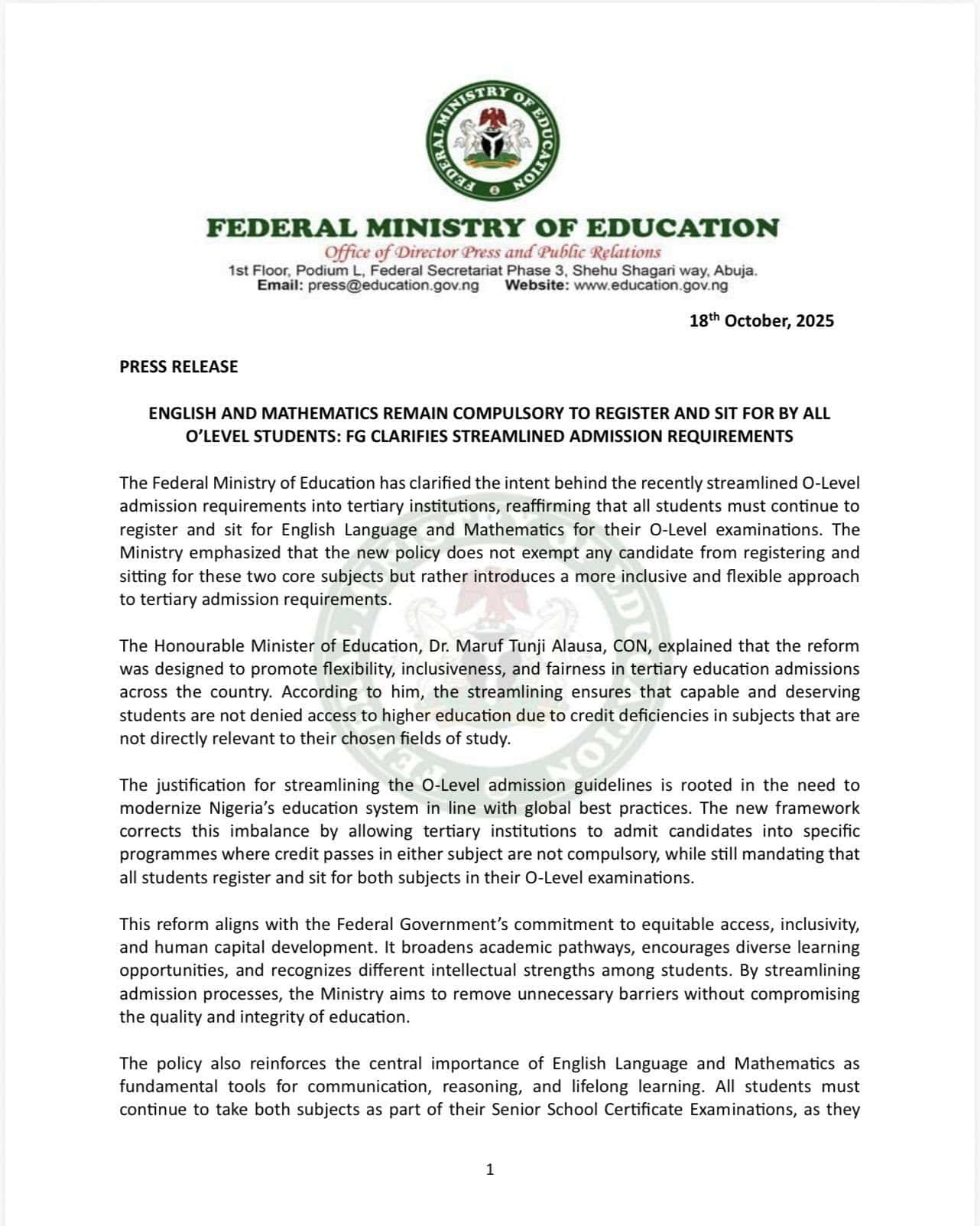
Updated: English and Mathematics Compulsory for O’Level -FG

The Federal Ministry of Education has cleared the air about the revised O’Level admission requirements for tertiary education. It confirmed that every student must still register and sit for English Language and Mathematics in their O’Level exams.

The Ministry explained that the new policy does not remove these two subjects but instead introduces a fairer and more flexible admission process. This approach helps ensure that students are not kept out of higher education because of credit issues in subjects that are not linked to their chosen courses.


According to the Honourable Minister of Education, Dr Maruf Tunji Alausa CON, the reform is meant to make the system more inclusive and fair for all learners. He stated that the adjustment supports equal access and creates more learning opportunities for students across Nigeria.

The update aims to modernise the education process in line with international standards. It allows tertiary schools to admit candidates into specific programmes where credit passes in English or Mathematics are not compulsory, while still requiring every student to register and sit for both subjects in their exams.

Dr Alausa added that this change reflects the Federal Government’s plan to promote equal access, fairness, and strong human capital development. By refining admission requirements, the Ministry hopes to remove barriers that prevent capable students from furthering their studies while keeping the quality of education intact.

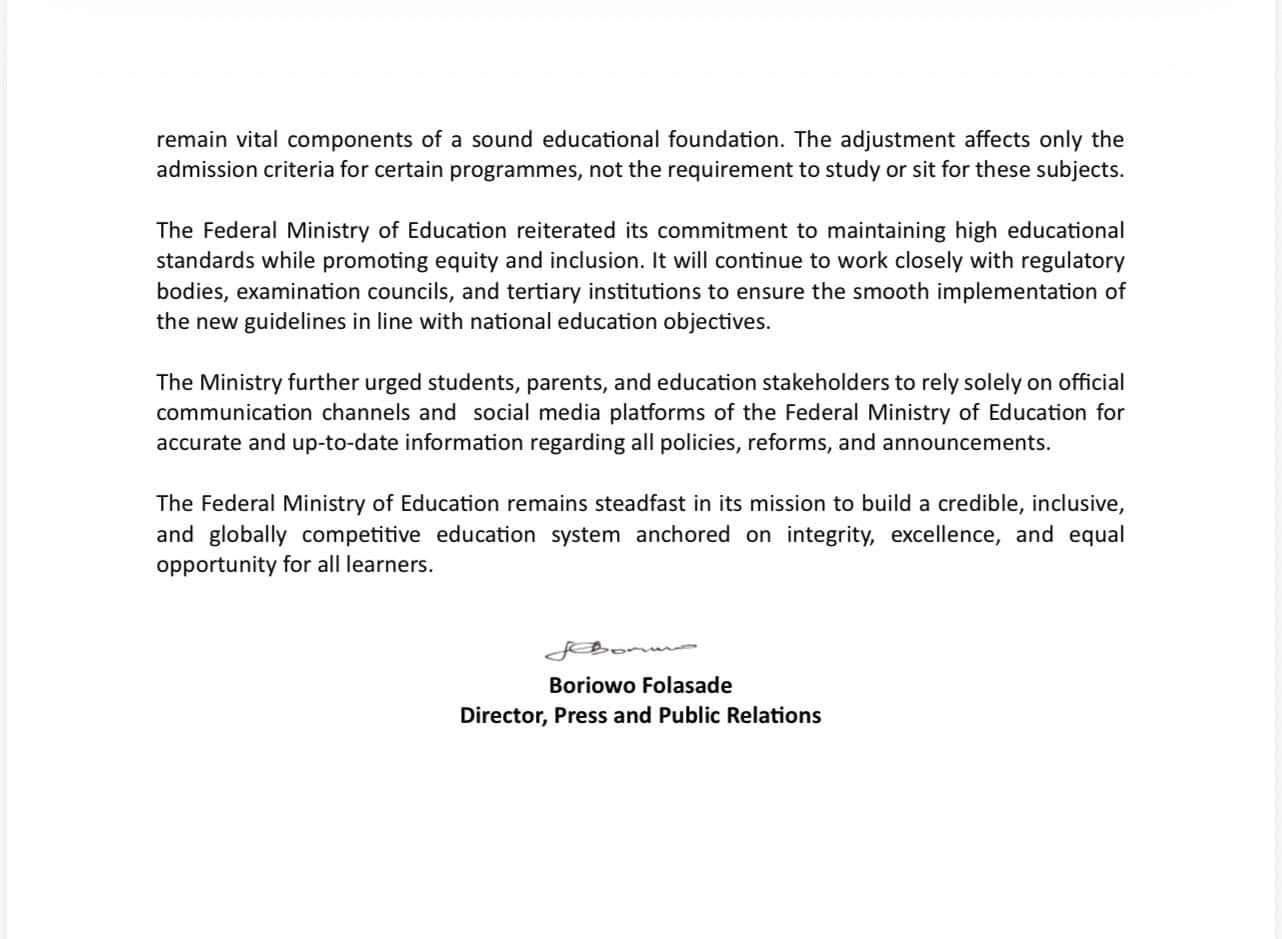
English and Mathematics remain at the heart of education. These subjects help students build essential skills in communication, problem-solving, and reasoning. Every candidate must continue to take them as part of the Senior School Certificate Examination. The adjustment affects only the admission process for some courses, not the need to study or sit for the subjects themselves.

The Federal Ministry of Education restated its dedication to keeping academic standards high while promoting inclusion and fairness. It will keep working with examination bodies, regulatory agencies, and tertiary schools to make sure the new rules are properly followed.

Students, parents, and educators are advised to rely only on official updates shared through the Federal Ministry of Education’s verified websites and social media pages. This will help prevent confusion caused by false or unofficial information.

The Ministry remains committed to building a trustworthy, inclusive, and globally respected education system that provides equal chances for every learner.

Federal Ministry of Education confirms English and Maths requirementMinister Maruf Tunji Alausa explaining O’Level policy update